Popular discussions about solid-state batteries have spurred development in both academia and industry. With a growing number of players working in this field and several milestones already achieved, the solid-state battery market is expected to reach $8 billion by 2031, according to the new IDTechEx report, "Solid-State and Polymer Batteries 2021-2031: Technology, Forecasts, Players.".
Solid-state batteries could be a game-changer.
In 2015, Volkswagen acquired a 5% stake in QuantumScape, Dyson acquired Sakti3, Bosch acquired SEEO, and Johnson Battery Technologies sold its solid-state batteries to BP. Although in 2017 Bosch divested itself of SEEO and was selling the company, and Dyson abandoned Sakti3 technologies, interest in solid-state batteries never waned. Ford, Samsung, and Hyundai invested in Solid Power. Hyundai also partnered with BMW. Renault, Mitsubishi, and Nissan invested in Ionic Materials. In 2020, Samsung produced new solid-state batteries based on argyrodite electrolyte, and Volkswagen made a new $200 million investment in QuantumScape. In addition to the companies mentioned, Honda, Fisker, Panasonic, and CATL also entered the market.
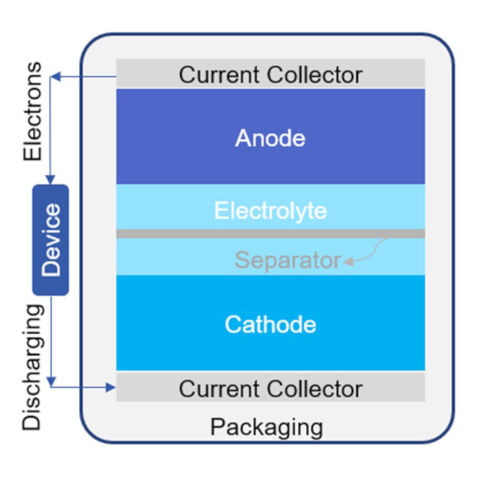
The flammable liquid electrolytes in most commercial lithium-ion batteries are considered a safety hazard because they can easily shrink under high temperatures, causing short circuits and subsequent fires. By replacing organic liquid electrolytes with their solid-state counterparts, solid-state batteries are safer and longer-lasting.
Greater safety means less safety control electronics in the battery modules/packs. Therefore, even though the first generations of solid-state batteries may have a similar or even lower energy density than conventional lithium-ion batteries, the energy available in the battery pack can be comparable to or even greater than that of the latter.
With the wider electrochemical window that solid electrolytes can provide, high-voltage cathode materials can be used. Furthermore, the high-energy-density lithium metal anode can push energy density beyond 1,000 Wh/L. These characteristics could make solid-state batteries a game-changer.
Lithium-ion battery manufacturing has been dominated by East Asia, with Japan, China, and South Korea playing a major role. The United States and European countries are now vying for market share, shifting the added value away from East Asia and building battery manufacturing closer to the application market. The selection of new materials and changes in manufacturing processes indicate a reorganization of the battery supply chain. From both a technological and business perspective, the development of solid-state batteries has become part of the next-generation battery strategy. It has become a global endeavor with regional interests and government support. Opportunities will arise with new materials, components, systems, manufacturing methods, and technical expertise.
The market will be driven primarily by the application of electric vehicles.
Demand for solid-state batteries comes mainly from electric vehicles. Energy storage systems and consumer electronics, such as smartphones, tablets, and laptops, are also target markets, and the latter may materialize sooner.
With mass production plans in place for most companies—Japan (around 2025-2030), Europe (around 2025-2026), and mainland China and Taiwan (around 2022-2023)—solid-state batteries are likely to take off after 2025, although small-scale production may begin even sooner. The plug-in vehicle market is expected to capture the largest share (66%) in 2031, followed by smartphone applications.
Interests are driven by the electric vehicle market, and regional convenience is a key consideration for the next stage of commercialization, especially given the current situation with COVID-19, which is impacting consumer purchasing decisions, lifestyles, and influencing globalization. This will lead to further consolidation and partnerships, and it is highly likely that new solid-state battery manufacturing centers will be located near electric vehicle application markets. Meanwhile, startups located far from application markets tend to license their technologies rather than build local manufacturing facilities.
Report Coverage:
The report "Solid-State and Polymer Batteries 2021-2031: Technology, Forecasts, Players" covers the solid-state electrolyte industry, offering a 10-year forecast to 2031 in terms of production capacity and market size, which is projected to reach over $8 billion. Special emphasis is placed on winning chemistries, with a comprehensive analysis of the eight inorganic solid electrolytes and organic polymer electrolytes.
Furthermore, the report covers the manufacturing challenges related to solid-state electrolytes and how major companies are addressing these limitations, as well as research advancements and the activities of key players. It also presents a study of lithium metal as a strategic resource, highlighting the strategic distribution of this material worldwide and its role in solid-state batteries. Some chemistries will have high lithium consumption and will put mining companies around the world to the test.