In this respect, bifacial photovoltaic modules are rapidly gaining ground in the current photovoltaic market, as a result of the widespread adoption of PERC technology and monocrystalline silicon, which has taken place since the late 2010s. In fact, the combination of bifacial modules with horizontal-axis solar trackers has led to the cheapest electricity in history.
The first industrialization of this bifacial technology in the world took place in Spain, in 1984, at Isofotón (Málaga), a spin-off of the Institute of Solar Energy of the Polytechnic University of Madrid (IES-UPM), whose name precisely reflects the bifacial nature of the technology. This system was developed at the time as a result of research activities in concentrated photovoltaics, and its production ended in 1989.
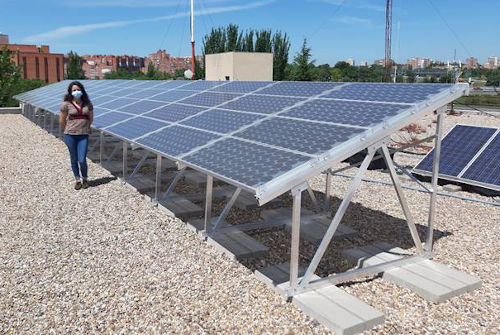
In early 2021, the IES-UPM (Technical and Industrial Engineering School of the Polytechnic University of Madrid) recovered 64 bifacial modules manufactured in 1987, which had been operating in various rural electrification installations—some for more than 20 years. These modules have been cleaned and characterized. As a result of this work, 56 of them have been installed on a fixed structure at the IES-UPM facilities and have been feeding energy into the grid since May 5, 2021. They thus constitute the oldest operating bifacial photovoltaic generator in the world, which has been named “Antecessor.” Its front-side power output is 3.75 kW.
“The modules are made with 10 cm diameter round monocrystalline silicon cells, encapsulated in EVA between a front glass sheet and a transparent back sheet. They were delivered 34 years ago with a nominal bifacial power of 90 W, measured with simultaneous front and rear illumination of 1000 W/m² and 500 W/m². Given their 70% bifacial coefficient, this translates to a nominal front power of 67 W,” explains Pablo Merodio of the UPM Solar Energy Institute. “Despite having been exposed to the sun for so many years, they are in very good condition, showing only some yellowing as a visual defect. More than 90% of them retain a nominal power of 59 W under standard conditions, which represents 90% of their nominal value. This allows for good energy efficiency,” he adds.
In its first week of operation, the Antecessor injected 142.5 kWh into the grid, receiving a frontal irradiance of 42.4 kWh/m² and a rear irradiance of less than 8% of the frontal irradiance, operating on a gravel surface with a 22% albedo. The corresponding frontal PR was 0.9.
For the IES-UPM researchers who participated in the recovery (in which Solar Jienense played a key role) and commissioning of these modules (Eduardo Lorenzo, Francisco Martínez, Miguel León, and Pablo Merodio), the social importance of this work lies in highlighting a historical milestone: the manufacture in the 1980s by Spanish industry of a technology that is currently booming and that many still consider "revolutionary."
More information at www.upm.es