In many industrialized countries, the automotive industry is one of the most important sectors of the economy. At its peak in 2017, 97.3 million vehicles (Statista) rolled off production lines worldwide. Due to the pandemic, this figure fell significantly to less than 60 million in 2020. The fact that many automakers are currently reporting record profits belies the true situation. This is because the pandemic, delivery bottlenecks, inflation, the war in Ukraine, and stricter climate targets are impacting the automotive industry during the most disruptive period in its history. The catalysts for this disruption are the electrification of powertrains, the rise of autonomous driving features, alternative mobility concepts, and the automation and networking of manufacturing.
Electric mobility is in the spotlight.
The shift from combustion engines to electric powertrains is of paramount importance to the public. The exhibitors at electronics 2022 play a crucial role here. For example, companies like Bosch, Infineon, Renesas, Rohm, STMicroelectronics, and Vishay are dealing with key components for power electronics. Silicon carbide (SiC) and gallium nitride (GaN) broadband semiconductors are setting new standards in this field in terms of switching frequency, efficiency, breakdown field strength, heat dissipation, and size. For electric and hybrid vehicles, this translates to greater energy efficiency, longer ranges, and shorter charging times. And development continues to advance, even for silicon-based power electronics. Through selective defect integration, scientists at Fraunhofer IKTS are achieving faster switching speeds and higher current handling.
A service in the form of mobility rather than hardware in the form of a car
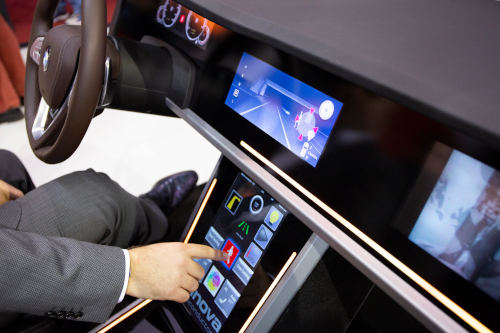
Along with the shift to electric mobility, significant changes in mobility behavior are altering the thinking of automotive industry executives. Digital mobility platforms promise individual mobility without the need for a personal car and threaten to cut off manufacturers' direct access to customers. If automakers don't want to become suppliers for multinational mobility companies, they must transform themselves into mobility providers. In this context, autonomous driving plays a crucial role. Starting at Level 4, cars become smart IoT devices. Consequently, the proportion of semiconductors in vehicles is once again increasing considerably.
The world's leading automotive chip manufacturers—Bosch, Infineon, NXP, Renesas, Samsung, STMicroelectronics, and Texas Instruments—will be represented at electronica 2022. NXP, for example, will present its S32Z and S32E processors, an extension of its S32 automotive platform for real-time processing of domain and zone control, security processing, and vehicle electrification. Infineon's multi-core SoCs from its Tc4x family will also cover a broad spectrum of automotive scenarios, from electric mobility, ADAS, and connected cars to AI implementation. The latter is increasingly used in network monitoring (intrusion detection and prevention systems), sensor fusion, battery management, and predictive control.
These multi-core SoCs already support future zonal architectures for electric vehicles, such as those being developed by Bosch and NXP. Across the board, the increasing complexity of software functions and the growing volume of data should be handled with fewer high-performance vehicle computers and zonal control units. With appropriate cloud connectivity, all kinds of features, such as vehicle-specific app stores, personalization, advanced driver assistance systems (ADAS), and comprehensive infotainment offerings, can be implemented and subsequently reserved via over-the-air (OTA) updates.
Industry Experts Conference
These future technologies, along with new strategies and business models, will be the focus of the electronica Automotive Conference, taking place on November 14, 2022, to kick off electronica. "Value chains in the automotive industry are being transformed by new E/E vehicle architecture concepts, driven by electric vehicles, and the separation of hardware and software through a few supercomputers instead of many individual control units," explains Peter Gresch, Managing Director of OptE GP Consulting and Chairman of the Electronica Automotive Conference Program Committee. He adds, "The electronica Automotive Conference will shed light on these massive changes and future trends through numerous specialist presentations, keynote addresses, and discussions, and will illustrate the new business potential."