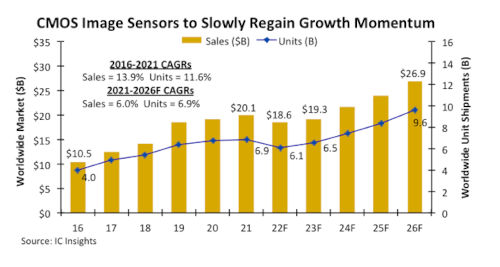
However, in 2022, the CMOS image sensor market category is on track to suffer its first decline in 13 years, with a forecast drop in sales of 7%, to $18.6 billion, and a decline in unit shipments of 11%, to 6.1 billion worldwide, according to the third quarter August update of The McClean Report service from IC Insights (Figure 1).
The projected decline in CMOS image sensors for 2022 follows two years of weak sales growth in 2020 (+4%) and 2021 (+5%). This year's sales slump reflects the overall weakness in consumer smartphones and laptops with digital cameras for video conferencing, following the surge in demand for internet connections and online conferencing capabilities during the COVID-19 pandemic. The Q3 Update forecast shows a modest recovery for CMOS image sensors next year, with market revenue growing by 4% to $19.3 billion and increasing by 13% in 2024 to reach a new record of $21.7 billion.
In addition to weak demand in consumer camera phones and laptops, CMOS image sensors have been negatively impacted by deteriorating global economic conditions stemming from high inflation and rising energy costs caused by Russia's war in Ukraine, as well as US trade sanctions against China, recent COVID-19-related shutdowns of Chinese manufacturing facilities, and a slowdown in the growth of the number of cameras included in new smartphones. Some high-end smartphone models contain five or more cameras, but the average for most phones has remained at three (one front-facing, user-oriented camera for selfies, and two main cameras on the back). According to IC Insights' Q3 update report, some executives in China have described the image sensor market conditions as a "perfect storm," combining a slowdown in mid-range smartphone shipments with an unexpected pause in the growth of integrated cameras being designed into new phones.
Sony, the market leader in CMOS image sensors, which accounted for approximately 43% of global CMOS image sensor sales in 2021, reported a sequential 12.4% decline in dollar revenue (-2% in Japanese yen) for its first fiscal quarter ending June 2022. In the first half of 2022, Sony struggled to meet the image resolution requirements of camera phones, and its CMOS image sensor sales to major Chinese system manufacturers were hampered by US trade restrictions. Sony continues to believe that excess inventory of phones and image sensors will decrease by early 2023 and that market conditions will normalize in the second half of its current fiscal year (ending next March).
Nearly two-thirds of CMOS image sensors are used in mobile phones, and that share is expected to fall to around 45% by 2026, according to The McClean Report's Q3 update. A slow but steady recovery for CMOS image sensors is anticipated, driven by a new smartphone upgrade purchase cycle and the integration of more cameras into other systems, particularly for automotive automation, medical applications, and smart security networks. The Q3 update shows that CMOS image sensor sales will increase at a CAGR of 6.0% between 2021 and 2026, reaching $26.9 billion in the final year of the forecast. Shipments of CMOS image sensors are projected to grow at a CAGR of 6.9% between 2021 and 2026, reaching 9.6 million units.