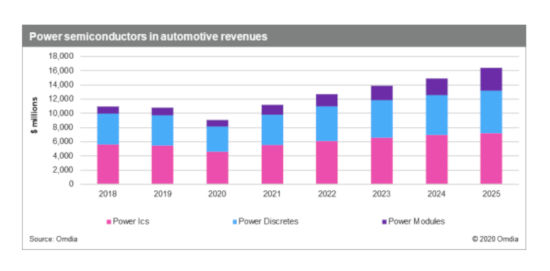
Global revenues from power semiconductors used in automotive applications will fall to $9.1 billion in 2020, down from $10.8 billion in 2019, according to Omdia's 2020 Power Semiconductor Report.
“2020 was expected to bring a rebound for the automotive power semiconductor market,” says Kevin Anderson, practice leader for power semiconductors, automotive, and industrial applications at Omdia. “However, the COVID-19 pandemic shut down most automotive assembly plants for several weeks, first in China and then in the rest of the world. At the same time, demand for new vehicles has declined as dealerships closed, jobs were lost, and wages were reduced in many parts of the world, compounded by the reduced demand.”.
Even those plants that have reopened are not operating at full capacity due to component shortages and reduced staffing on production lines as physical distancing measures are implemented. As a result, current forecasts for new vehicle manufacturing predict production of fewer than 70 million units in 2020, a decrease of more than 20 percent from 2019.
Power semiconductor devices, including power discrete devices, power modules, and power integrated circuits (ICs), are widely used in all automotive electronic systems. This widespread adoption has driven strong single-digit annual growth rates for the automotive power semiconductor market in recent years.
However, 2019 brought a change in that trend. Trade tensions throughout the year, combined with intermittent tariff negotiations and a slowdown in some regional economies, reduced vehicle manufacturing and caused the automotive power semiconductor market to decline by 1 percent compared to 2018.
After experiencing low-single-digit declines in 2019, discrete power semiconductors and power integrated circuits for automotive applications are expected to post a sharp revenue loss of 17 percent this year. These devices are used in all vehicle electronic systems, and because the electronic content and complexity of those systems are increasing, the impact of lower vehicle production on their revenue has been limited.
Power module revenues grew by 7 percent in 2019, benefiting from increased manufacturing volumes of electric vehicles (EVs) and hybrid electric vehicles (HEVs). Similarly, only an 8 percent decrease in power module revenues is forecast for 2020.
The revenue outlook for several automotive sectors is also mixed.
Revenue in the fast-growing advanced driver assistance systems (ADAS) module market increased by 12 percent in 2019 and is expected to decline by only 3 percent in 2020. In powertrain systems, revenue grew by 1 percent in 2019 and is forecast to decline by 13 percent in 2020. Sales of higher-value power modules are expected to increase due to the automotive market's shift to electric vehicle/electric vehicle (EV) production. The other sectors (chassis and safety and infotainment) grew at single-digit rates in 2019 and are expected to decline by a significant 20 percent in 2020.
The recovery reaches the driver's seat by 2021
As major global economies seek to reopen after lockdowns, a gradual increase in sales is expected in the second half of 2020. If a severe second wave of the virus can be avoided and a COVID-19 vaccine or improved treatments can be developed by early 2021, then a rebound in vehicle sales is projected for 2021.
This would result in a near-mid-range increase in power semiconductor sales of 20 percent in 2021. In addition, the long-term compound annual growth rate (CAGR) would return to 7 percent for the years 2019-2025.
The Omdia Power Semiconductors in Automotive Report -2020 presents a much deeper analysis of the market, including breakdowns by 35 electronic application areas and 30 different types of semiconductor devices.