

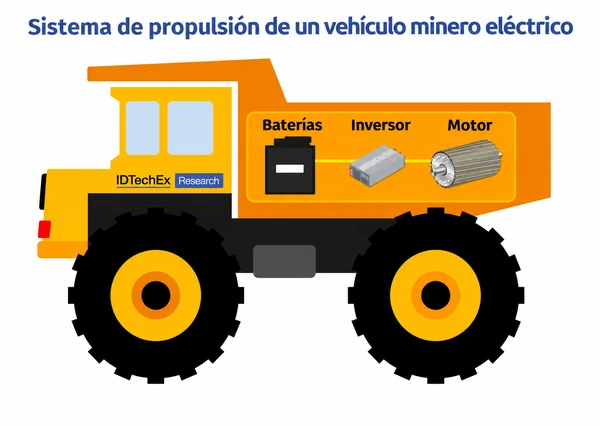
Unlike other transport sectors, the electrification of mining machinery presents specific requirements derived from the large dimensions of the vehicles, their prolonged operating cycles and exposure to adverse environmental conditions.
These factors are driving the development of batteries, electric motors and power inverters specifically adapted to mining applications, as analyzed by IDTechEx in its report "Electric Vehicles in Mining 2027-2047: Technologies, Players, Forecasts".
Higher capacity batteries and charging systems up to 6 MW
The size of mining machinery and its demanding work cycles require high-capacity energy storage systems. Most large haul trucks weigh over 150 tons, while the largest models reach 350 tons. These vehicles must transport loads exceeding their own weight during virtually uninterrupted operating cycles, requiring batteries with capacities on the order of megawatt-hours (MWh).
The maturity of the battery industry and the reduction in the price of lithium-ion cells have facilitated the commercialization of these storage systems. According to IDTechEx, the highest capacity battery currently used in mining machinery reaches 2.4 MWh, compared to 1.9 MWh in 2024.
At the same time, the need to minimize downtime is driving the development of charging systems capable of delivering sustained power outputs exceeding 3 MW, with new solutions under development aimed at reaching 6 MW. However, fast charging at high C-rates can accelerate battery degradation and reduce their lifespan, increasing the risk of battery replacement during the machinery's operating period.
LTO batteries with a lifespan of up to 60,000 cycles
Lithium titanate (LTO) anode battery technologies represent a promising alternative for mining applications. Replacing the graphite anode with an LTO anode, typically combined with an NMC (nickel-manganese-cobalt) cathode, reduces the energy density of the cells but also significantly limits volume variations during charge and discharge cycles. According to IDTechEx, this technology allows for a lifespan of between 20,000 and 60,000 cycles, in addition to offering greater tolerance to fast charging at high C-rates.
Although LTO batteries have a lower energy density and cost approximately $750/kWh, these limitations are relatively less significant for heavy mining equipment. Increased productivity and longer battery life can help offset the higher initial investment.
Efficiency and cost in the design of electric motors
Energy efficiency and cost are two of the main parameters that mining machinery manufacturers seek to optimize when designing motors and inverters. Even small improvements in the efficiency of the propulsion system can significantly reduce the required battery capacity, one of the main cost factors for these vehicles.
Permanent magnet (PM) motors are generally among the most efficient commercially available technologies. However, the use of rare earth elements in their magnets involves high costs and potential supply limitations. This situation has led manufacturers such as Caterpillar, Dana, and Turntide to consider alternatives like switched reluctance motors (SRMs), which offer lower costs and high durability, although they generally have lower efficiency.
Power inverters with silicon IGBTs and silicon carbide MOSFETs
Selecting power semiconductor technology for mining equipment inverters also requires balancing performance and cost. Both silicon (Si) IGBTs and silicon carbide (SiC) MOSFETs have already been introduced to the mining market. The former offer lower costs, while SiC devices provide better performance.
The choice of motor architecture and inverter technology will depend on the machine's dimensions, its operating requirements, costs, and the availability of technologies and suppliers. Furthermore, the mining sector is embracing the trend toward integrated electric propulsion systems, combining motors, inverters, axles, and other components into a single solution. This integration allows manufacturers to reduce development costs and obtain more efficient and economical propulsion systems, facilitating the electrification of mining machinery.
Electric vehicle market forecasts for mining until 2047
The IDTechEx report analyzes the main factors driving and limiting the electrification of the mining sector, including technological comparisons, case studies of the main manufacturers and analysis of the total cost of ownership (TCO).
IDTechEx predicts that the development of new battery technologies, charging systems, electric motors and power inverters will be key to this market exceeding $27 billion by 2047.