




Battery manufacturers and automotive OEMs will seek to retain these critical and strategic raw materials (CRMs) within their supply chains to help meet demand for new Li-ion batteries, while regulators will seek to retain CRMs within their region's borders to minimize dependence on supply from other countries.
EU Critical Raw Materials Act:
On November 13, 2023, the European Parliament reached an agreement on the Critical Raw Materials Act (CRMA), but the Council must now formally approve this new legislation before its publication in the Official Journal of the EU. The aim of this Act is to keep CRMs within the EU and "protect the Union from the growing mismatch between supply and demand on a global scale." This will be important not only for the lithium-ion battery market but also for other sectors, such as security, defense, agriculture, healthcare, and construction.
The document outlining these agreements, entitled "Framework to Ensure a Secure and Sustainable Supply of Critical Raw Materials," details 34 critical raw materials and 17 strategic raw materials. Critical raw materials are defined as those of great importance to the EU economy and subject to high levels of supply risk. Strategic raw materials are those with high economic returns, used in technologies supported by green, digital, defense, or aerospace applications, and are potentially subject to future supply risks. The most relevant materials for the lithium-ion battery market included on both the CRM and SRM lists are lithium, manganese, natural graphite, and nickel, while cobalt is listed as a CRM and copper as an SRM.
To keep these materials within the EU, Parliament agreed on several targets to be achieved by 2030 to reduce dependence on third countries. First, no more than 65% of the EU's supply of each strategic raw material (SRM) should come from a single third country, with the aim of reducing the EU's reliance on China and diversifying its SRM supply. Second, at least 10% of the EU's annual consumption of strategic raw materials should come from EU extraction. Third, at least 40% of the EU's annual consumption of strategic raw materials should be processed within the EU. Finally, and potentially most ambitiously, "the Union's recycling capacity should be able to produce at least +10% more recycling capacity volume based on the 2020-2022 baseline for each strategic raw material to collect, sort, and process at least 45% of each strategic raw material contained in Union waste, taking into account technical and economic feasibility.".
The wording of this statement can be confusing, as it does not explicitly stipulate whether collected batteries should be processed or recycled. For example, if a lithium-ion battery were to be recycled "fully," this could involve producing new cathode active material (CAM) via a hydrometallurgical process, which could then be used in new batteries. In contrast, if a lithium-ion battery were to be "processed," this would only involve producing black mass through mechanical processing. This black mass would require further refining to convert it into battery-suitable metal salts before further processing to produce CAM. Arguably, this additional recycling step would take place outside the EU, but as long as 45% of the MER (Recycled Materials in the EU) are "processed" within the EU, this claim could be considered fulfilled. Therefore, clearer and more explicit terminology is needed to ensure that these SRMs are retained within the EU at the endpoint of a given recycling process, thus guaranteeing the performance of usable materials in new batteries.
Comparison with the targets of the EU Battery Regulation
It is important to consider how this compares with the EU Battery Regulation, which came into force in August 2023. This regulation details the collection rate and recycling efficiency targets for lithium-ion batteries.
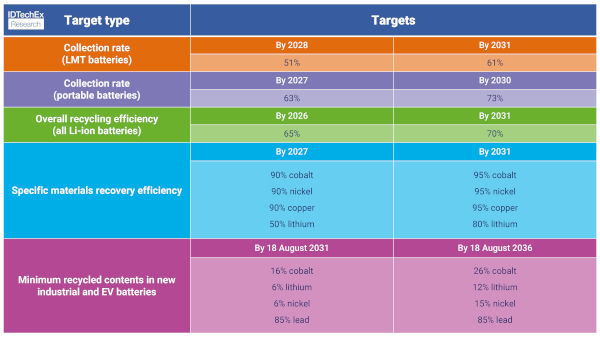
EU Battery Regulation recycling targets. Source: IDTechEx
By 2026, the recycling efficiency of lithium-ion batteries should be at least 65%, and by 2031, at least 70%; these targets are higher than the CRMA's 45% recycling target. The collection rate targets for light transport (LT) batteries and portable batteries (which would contain several MERs) in 2028 and 2027, respectively, are higher (51% and 63%, respectively) than the CRMA's 45% target for 2030. Therefore, assuming the targets of the EU Battery Regulation are met, lithium-ion battery recyclers will help contribute to the Union's lower target of collecting, sorting, and processing 45% of each MER. In any case, it remains an ambitious goal overall, since these SRMs are also used in broader sectors, creating a dependence on other industries whose products use these SRMs to achieve these collection rates and recycling efficiencies.
Call to improve product design to enhance circularity
The EU agreement also addresses the fact that "recycling and reuse rates for most critical raw materials are low, due in part to a lack of consideration for recyclability during the product design phase." Ultimately, this is hindering the potential circularity of these materials within supply chains. Therefore, the next decade could see improvements in the design of electric vehicle batteries that allow for simpler and faster dismantling procedures. This would help improve the recyclability of lithium-ion batteries in electric vehicles.
Improvements in EV battery design, such as the adoption of cell-to-pack designs, would eliminate the need for a separate module and its associated connections, thus allowing recyclers and second-life reusers to access cells for processing more quickly, safely, and economically (although cell-to-pack designs do present challenges due to increased use of structural adhesives). Historically, battery manufacturers and original equipment manufacturers (OEMs) have focused on designing EV batteries to improve performance, safety, and lifespan. However, these EU statements may prompt manufacturers to begin designing their batteries with greater consideration for ease of end-of-life processing. Ultimately, incentives for designing new batteries with improved end-of-life processing capabilities, or penalties for failing to do so, may need to be introduced to ensure these measures are implemented.
Future prospects for critical and strategic raw materials:
CRMA is vital for the EU to keep its critical and strategic raw materials within its borders and reduce its dependence on supplies from third countries. Several targets have been agreed for 2030, but the Council must formally approve them before publication in the Official Journal of the EU. The 2030 target of "collecting, sorting and processing at least 45% of each SRM contained in Union waste" is arguably ambitious. Although the EU Battery Regulation sets more ambitious targets for the collection and recycling of certain lithium-ion batteries by 2030, other industries that use SRM will also need to ensure that their collection systems and recycling processes can help meet this target. At least in the lithium-ion battery market, the pressure to keep critical materials within a region's borders or supply chain doesn't just stem from a regulatory perspective, as manufacturers and OEMs are also aware of the importance of recycling, especially since demand is expected to continue growing rapidly in the coming decades.
Ultimately, all stakeholders across the value chain will play a significant role in achieving these objectives in the EU. For example, battery manufacturers and automotive original equipment manufacturers (OEMs) would benefit from designing their lithium-ion batteries with greater circularity in mind, for instance, through simplified designs that reduce the number of connections in an electric vehicle battery pack. This will improve recycling efficiency while potentially reducing costs for manufacturers and OEMs who source their critical or strategic raw materials back from lithium-ion battery recyclers.
Author: Conrad Nichols, technology analyst at IDTechEx







