

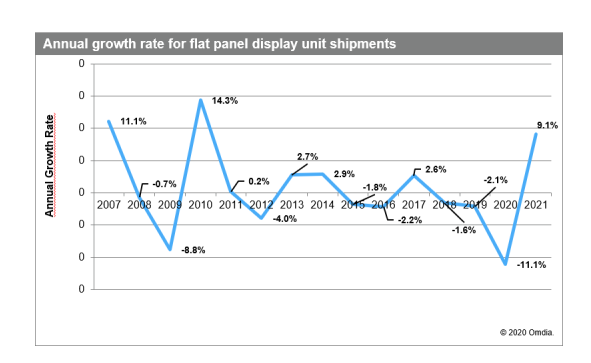
FPD sales are projected to reach a total of 3.2 billion units in 2020, down from 3.6 billion in 2019. The market has experienced single-digit increases and decreases since the financial crisis in the second half of 2008, which caused sales to fall by 8.8% in 2009. However, this year's double-digit decline will represent an unprecedented rate of decrease, according to long-term demand research firm Omdia.
“The coronavirus is spreading around the world at a faster rate than expected,” says Ricky Park, head of display research at Omdia. “The pandemic is beginning to directly impact app market demand as stores close and lockdowns become widespread, weakening consumer accessibility. In particular, TVs and smartphones, products heavily reliant on retail consumer demand, will struggle to avoid the direct impact of the coronavirus and will be more severely affected by the outbreak than other sectors. This will result in a sharp decline in global demand for flat-screen displays in 2020.”.
Omdia predicts the market will recover in 2021 as the impact of the coronavirus recedes, with sales increasing by 9.1 percent during the year.
TV and smartphone sales:
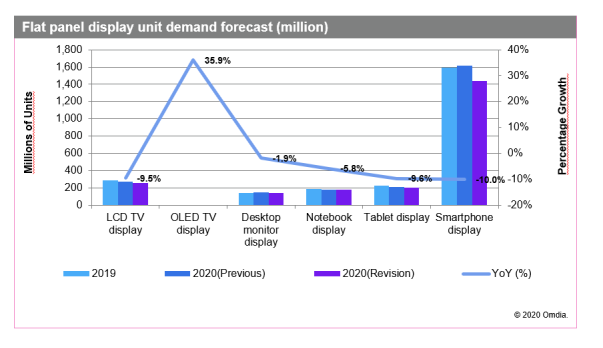
Omdia has cut its forecast for demand for LCD TV screens and smartphones in 2020. Sales of LCD TV screens are expected to fall by 9.5 percent, while smartphone sales are expected to fall by 10 percent.
Initially, major global sporting events were expected to be the main drivers of growth this year. However, most of these events have now been canceled or postponed.
Monitors and laptops remain stable.
Despite these challenges, desktop monitors and laptop screens should perform relatively well, experiencing only a 1.9 percent and 5.8 percent decline, respectively, in 2020. Consumers account for less than 40 percent of the demand for these displays, with the remainder coming from the commercial sector. As many countries impose restrictions on economic activities, this will increase the amount of working from home, leading to relatively stronger demand from corporations. In addition, with school closures and online courses becoming more prevalent, households and schools are demanding more laptops and tablets.
 Sales ready for decline
Omdia has also reduced its 2020 projections for global flat panel unit and revenue by 4.5 percent and 4.0 percent, respectively, compared to previous outlooks.
However, in terms of size, demand is expected to grow by 1.8 percent in 2020, driven by increased demand for large displays. Large display suppliers are achieving better performance rates and lower costs, making their products more attractive. Suppliers are also offering more foldable and frameless displays.
Korean suppliers are migrating to more advanced displays.
Korean brands have aggressively withdrawn from their LCD production lines and switched to advanced displays. This should result in a significant drop in the production of small/medium-sized TV panels at Gen 7 and Gen 8 factories and, over time, should drive growth in sales of 60-inch and larger TV panels.
Regarding AMOLED demand, although Omdia's original outlook was revised downward, demand growth in terms of units is expected to be relatively high, at 9.5 percent in 2020. Demand for OLED TV panels is projected to grow by approximately 35.9 percent, and AMOLED demand for smartphones is projected to grow by approximately 9.0 percent.
Demand for advanced display technology should remain strong, despite the overall market downturn.