




The strong growth of MCUs for IoT applications and the race among vendors to acquire market share in this IC segment have resulted in several major acquisitions that changed the hierarchical order of MCU leaders in 2016, according to data published in IC Insights.
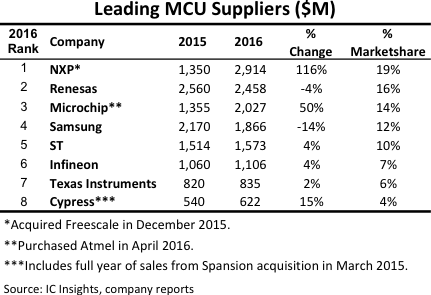 Figure 1 ranks the largest MCU vendors in 2016 by dollar sales volume. Among the top MCU vendors shown, NXP, Microchip, and Cypress Semiconductor climbed in the sales rankings during 2016 with strong revenue increases, driven by acquisitions of IC companies that sold microcontrollers. Meanwhile, vendors that did not make significant microcontroller acquisitions saw low or single-digit percentage increases or decreases in MCU sales in 2016.
Although overall microcontroller growth has faltered and stagnated over the past two years, MCUs remain at the heart of tremendous growth in the Internet of Things, automotive, robotics, embedded applications, and other emerging systems. Major MCU vendors have enhanced their portfolios to address many of these key markets. Part of this enhancement process has included mergers and acquisitions of competitors to gain a foothold in these developing markets.
In 2016, NXP overtook Renesas Electronics as the world's largest microcontroller vendor, with MCU revenues surging 116% following its acquisition of Freescale Semiconductor in December 2015. Prior to the acquisition, Freescale held second place in MCUs and was catching up with Renesas in microcontroller sales, with only $210 million separating the two companies in 2015, up from a gap of $1 million in 2014. Renesas experienced a 19% decline in MCU sales in 2015 (largely due to the weak yen exchange rate that year, but also due to the ongoing fallout from Japan's turbulent economy). In 2016, Renesas's decline in MCU sales slowed, falling 4% to nearly $2.5 billion, or about 16% of the total microcontroller market. In 2011, Renesas' MCU market share represented 33% of global microcontroller sales.
The acquisition of Freescale propelled NXP from sixth place in the 2015 MCU rankings to the top in 2016 with a 19% market share (US$2.9 billion). Nearly three-quarters of NXP's 2015 microcontroller sales were 8-bit and 16-bit MCUs used on smart boards. After the Freescale business merged with NXP, smart board MCUs accounted for slightly more than a quarter of the company's total microcontroller sales in 2016. MCUs developed and introduced by Freescale target a wide range of embedded control applications. NXP and Freescale have developed 32-bit MCUs with Cortex-M CPU cores licensed from ARM in the United States.
US-based Microchip Technology climbed from fifth to third in the 2015 MCU rankings to third in 2016, with sales increasing 50% to $2 billion following its acquisition of Atmel in Q2 2016. Atmel, also based in the US, ranked ninth in MCU sales in 2015 ($808 million). Before acquiring Atmel, Microchip had been the only major MCU vendor that did not license ARM CPU technology. For about 10 years, Microchip had developed and sold 32-bit MCUs based on a RISC processor architecture developed by MIPS Technologies (now owned by Imagination Technology in the US, an ARM rival). Six months after completing the Atmel acquisition, Microchip said it would expand both its MIPS-based PIC32 MCU product line and Atmel's ARM-based SAM series. Microchip has promised to "remain agnostic, tailoring the best solution to the right customer and for the right application.".
Meanwhile, Silicon Valley-based Cypress ranked eighth in the MCU market, with sales increasing 15% in 2016 to $622 million. Cypress boosted its MCU presence when it acquired Spansion for around $100 million in March 2015. Spansion had purchased Fujitsu Semiconductor's MCU and analog divisions in 2013 as part of its efforts to expand its non-volatile storage IC portfolio. Spansion also licensed ARM's 32-bit CPU cores for microcontrollers in 2013. Cypress's increase in microcontroller sales was partly due to not only having a full year's worth of revenue from Spansion's MCU business, but also to the growth of the company's PSoC products, which combine microcontroller functionality with user-configurable mixed-signal and digital peripherals targeted at end-use applications.
The biggest decline in the list of MCU leaders was Samsung, which saw its sales fall by 14% in 2016, mainly due to weakness in the smart card microcontroller.







