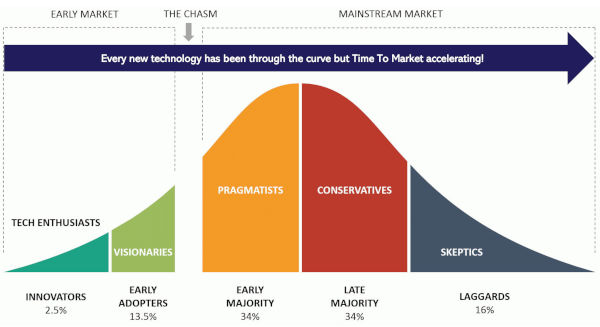
The pace of innovation is also accelerating in other areas, driven by shifts in habits and new priorities brought about by the pandemic. The examples below illustrate existing trends that will be significantly accelerated, further demanding the use and development of efficient, compact, and modular power delivery networks (PDNs).
Forecast #1 – Automotive: Covid has accelerated the adoption of electric vehicles and 48V systems, by Nicolas Richard, Director of Automotive Business Development EMEA at Vicor
Transportation has been one of the sectors most affected by the global pandemic, as fewer people are traveling both short and long distances. The automotive industry has experienced a rapid decline in sales, and indications continue to point in this direction well into 2021. Manufacturers have responded by placing greater emphasis on growth segments, specifically electric vehicles. While they have cut back on the development of traditional cars, they are accelerating the development of electric vehicles, focusing on technology that provides a competitive advantage. Although fewer people are traveling, studies indicate that people feel much safer when using their own cars instead of public transportation. Consequently, we believe this will accelerate the need for affordable electric vehicles, and the trend of replacing 12V power grids with 48V will accelerate significantly due to increased investment in development.
In 2021, the presence of 48V battery systems will increase, especially in mild hybrids, as manufacturers add active suspension systems, rear-wheel steering, and rollover stabilization. To make all this a reality, more 48V-to-12V conversion systems will be needed for safety, comfort, infotainment, and navigation systems. Besides reducing wiring and providing more power, converting high-voltage batteries in hybrid and electric vehicles is more efficient when the voltage drop is reduced as the voltage increases to 48V. Primary battery voltages for electric and hybrid vehicles will also increase, with 800V becoming much more common to allow for faster charging times.
These changes demand a new class of power components to create a distributed power network in next year's cars.
Forecast No. 2 – High-performance computing: Demand for data center capacity will outpace physical space on the plant floor, by Lev Slutskiy, Regional Director of Vicor.
Data centers were already growing rapidly, but the pandemic has accelerated demand beyond expectations, and this growth will continue even after the coronavirus is defeated. With more people working remotely, more students learning from home, and fewer leisure options outside the home, more streaming videos are being downloaded and more online gaming is taking place. We have seen firsthand the extent to which users rely on the metropolitan networks that form the current telecommunications infrastructure. In 2021, the pursuit of more energy-efficient data centers will take a significant step forward, and we believe this industry will not only rely more on renewable energy than in previous years but also see more data centers transitioning from AC to DC infrastructure to better meet the enormous increase in power demand for high-performance computing.
This rapid and unforeseen acceleration in demand far exceeds the capacity of physical data centers; therefore, data center operators need more capacity in the same space, which has significant implications for their power supply. It is more important than ever to be able to deliver more efficient power in the same space with excellent thermal management. Artificial intelligence (AI), cloud computing, and big data are driving the demand for much greater processing power, resulting in significantly higher energy consumption and current draws, which in turn increases electricity losses due to power conversion and transformation processes. A third area of significant change in data center innovation is related to power supply and its efficiency at the cabinet and rack level to support the increased computing power (on the order of exaFLOPS) required by cloud, AI, and big data applications.
A more efficient way to manage power is to increase the voltage in these systems and use direct current, either by rectifying alternating current or directly from a renewable energy source. The conversion of high voltage (typically 260–410 V DC) to the values used at the input of modern computer equipment (12 V or, preferably, 48 V) could be performed by bus converters. We believe that system designers will increasingly employ these innovative solutions in their architectures, such as Factored Power Architectures (FPAs) and efficient converter modules, to shorten the distance between the high-current supply module and the point of load (PoL). This will reduce the resistance of the power network and thus minimize power losses in future supercomputing applications. Some manufacturers of high-performance computing (HPC) solutions, such as Nvidia (which recently ranked 1st, 3rd, 4th and 5th on the Green 500 list), have adopted this strategy to make data centers greener.
Forecast No. 3 – Military and Aerospace – The three major catalysts for change in 2021 will be the pandemic, hypersonic missiles and asymmetric warfare, by Teo DeLellis, Director of Aerospace Business Development at Vicor.
As a result of the enormous investments made to combat COVID-19, governments worldwide have established new priorities and adopted economic support measures to help communities, businesses, and citizens cope with the pandemic's impact. A recent study by Jane's in June 2020 highlighted that defense spending is declining in major NATO countries. Consequently, at the beginning of 2021, governments will face immense fiscal pressure to cut their budgets in areas such as defense in order to strengthen their economies, social welfare, and other important objectives. This measure does not take into account the geopolitical pressures stemming from rising nationalism on many levels. One example of this is Sweden's decision to increase its military spending by 40% due to heightened tensions with Russia.
We believe that technology and innovation will have to fill the gaps created by these conflicting pressures so that governments can do much more with less, such as maintaining their military response capabilities through new digital technologies. In the US, the threat of hypersonic missiles from Russia and China has accelerated defensive and offensive missile programs, resulting in a level of innovation initially projected for five years from now. Asymmetric warfare will also be a major driver of change in 2021, as the possibility of drone swarm attacks exposes high-value targets to low-cost drones, and it is not sustainable to eliminate a $1,000 drone with a $100,000 missile. This will drive technological advancements such as greater integration of AI into defense systems and the deployment of lasers capable of more effectively countering the threat of these drone swarms. Drone technology will continue to dominate the reconnaissance segment, and power technology will contribute to increasing the distance and time that missions can cover.
Forecast No. 4 – Robotics: The number of drones and robots in Europe will be 747 million in 2021, by Henryk Dabrowski, Vice President of Sales in EMEA at Vicor.
By the end of 2021, for every woman, man, boy, and girl in Europe, there will be at least one delivery robot or drone tasked with delivering a package or disinfecting public spaces as part of our fight against the pandemic. Robotics innovation will also experience a significant acceleration as companies turn to robots to safely engage with customers and perform tasks without exposing people to the coronavirus. To meet this demand, robotics developers will need to leverage existing designs and use them as platforms rather than trying to develop entirely new robots. Sizing these platforms will require adapting the power output to each power level to accommodate the different sizes and capabilities of the robots. A key requirement for overcoming this challenge will be a modular and scalable approach to powering.
Key factors driving the expansion of automated delivery services include the autonomy and weight of the robot or drone. Vicor enables designers to lighten their drones to improve performance and manage power so they can fly farther and more reliably than ever before.
We anticipate that robots will be used more than drones in the most densely populated areas of European cities, while in more remote regions like the Alps, drones will be used more frequently to assist in emergencies and deliver vital medical supplies, while heavier loads will be handled by autonomous trucks. In Europe, Tesco, Amazon, DHL, and UPS have already begun testing delivery drones, and the pandemic represents a turning point in the retail sector's push toward complete digital transformation. The convenience of home delivery, which people have become accustomed to during lockdowns, means that in-store shopping at shops and supermarkets will not return to pre-pandemic levels. The use of robots on the streets and drones in the air will allow retailers to supply their products at a lower cost. In China, drones have already begun making deliveries in remote areas of the country, and we have observed rapid progress in which logistics companies have obtained permits from aviation authorities for commercial drone operations.