X-rays revolutionized medicine, allowing us to see through the skin without surgery. Similarly, terahertz spectroscopy penetrates layers of graphene, enabling scientists to map its quality and electrical properties without damaging or contaminating the material. The Graphene Flagship, a project funded by the European Commission, fostered collaboration among researchers at various universities and companies to develop and refine this analytical technique. Now, the new tool for characterizing graphene is ready.
This effort was made possible by the collaborative ecosystem of the Graphene Flagship, with the participation of scientists from DTU, Denmark; IIT, Italy; Aalto University, Finland; AIXTRON, UK; imec, Belgium; Graphenea, Spain; the University of Warsaw, Poland; and THALES, France, as well as external collaborators in China, Korea, and the USA.
Graphene is often found sandwiched between different layers of materials within photonics and electronics devices. This complicates quality control processes. Terahertz spectroscopy makes things easier; it allows for imaging of encapsulated materials, revealing the quality of the graphene inside and showing any imperfections generated during the manufacturing process. Thanks to this fast and non-destructive technology, the electrical properties of graphene and other two-dimensional materials can be analyzed without direct contact.
The development of characterization techniques like terahertz spectroscopy is fundamental to accelerating large-scale graphene manufacturing, as it ensures that devices are manufactured consistently, reproducibly, and without errors. Quality control is essential for building trust. Thanks to the work of the Graphene Flagship, continuous graphene production methods like the roll-to-roll system are already on the market. Now, terahertz spectroscopy guarantees that graphene production can be scaled up without affecting its quality. 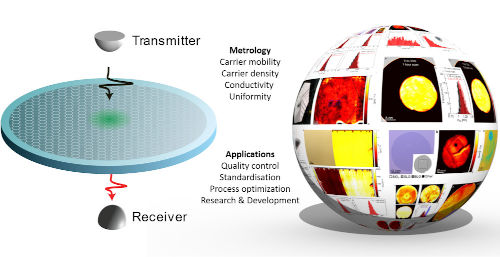
“We needed this technique to ensure quality that matched the production levels achieved by the Graphene Flagship,” explains Peter Bøggild, a researcher at DTU, Denmark, an institution belonging to the Graphene Flagship. “Terahertz spectroscopy will be to graphene manufacturing what X-rays are to hospitals—it will become a routine technique. With it, you can map square meters of graphene without touching it, which isn't possible with any other current technique.” Furthermore, the Graphene Flagship is now exploring how to implement this quality control system directly in its continuous roll-to-roll graphene manufacturing devices. Collaboration
was crucial to achieving this milestone. Graphene Flagship researchers at academic institutions have worked closely with leading companies in the sector, such as AIXTRON, Graphenea (in San Sebastián), and IMEC. “This is the best way to guarantee that our technique is useful for our users—the companies that manufacture graphene and two-dimensional materials every day,” adds Bøggild. “Our article systematically reviews the versatility, potential, and reproducibility of terahertz spectroscopy for quality control and should guide our colleagues in applying the technology to industry-relevant substrates such as silicon, sapphire, silicon carbide, and polymers,” he adds.
Developing standards is important for developing and commercializing new materials, as they guarantee safety and authenticity and ensure that results are consistent and reliable. For this reason, the Graphene Flagship has a working group dedicated to standardizing graphene, as well as the measurements and analytical techniques associated with industrial manufacturing processes. This new terahertz spectroscopy method is on the verge of becoming a standard technique, thanks to the work of the Graphene Flagship standardization committee. “This will undoubtedly accelerate the adoption of the technology, as it guarantees a standard and reproducible way to analyze and compare graphene samples,” says Peter Jepsen, a researcher at DTU, Denmark, a member of the Graphene Flagship. “Terahertz spectroscopy is another step toward increasing confidence in graphene products,” she adds.
Amaia Zurutuza, co-author of the article and scientific director of Graphenea, a Graphene Flagship company, says: “At Graphenea, we are convinced that terahertz spectroscopy will ensure the development of quality control techniques that can be scaled to the production levels we need, guaranteeing the manufacture of high-quality graphene, essential on our path to industrialization.”
Thurid Gspann, coordinator of the Graphene Flagship standardization committee, adds: “Terahertz spectroscopy will be adopted by industry; it requires no sample preparation and allows for the mapping and analysis of large areas quickly and very efficiently.”
Marco Romagnoli, director of the electronics and photonics division of the Graphene Flagship, comments: “Terahertz spectroscopy is a cutting-edge technique for scaling up electronic applications, a high TRL system for characterizing multiple layers of graphene deposited on silicon wafers. It operates quickly and accurately, providing information on several interesting parameters such as mobility, conductivity, scattering time, and charge density. This achievement is highly valuable and demonstrates the importance of developing cross-cutting, multidisciplinary projects like the Graphene Flagship.”
Andrea Ferrari, STO of the Graphene Flagship, adds: “Once again, Graphene Flagship researchers have led the way in creating a characterization technique to facilitate the development of technology with graphene and two-dimensional materials. This will help us progress, continue innovating, and enable industry to continue using graphene in a wide range of applications.
Reference:
“Case studies of electrical characterisation of graphene by terahertz time-domain spectroscopy.” P. R. Whelan, B. Zhou, O. Bezencenet, A. Shivayogimath, N. Mishra, Q. Shen, B. S. Jessen, I. Pasternak. DMA Mackenzie, J. Ji, C. Sun, P. Seneor, B. Dlubak, B. Luo, FW Østerberg, D. Huang, H. Shi, D. Luo, M. Wang, RS Ruoff, BR Conran, C. McAleese, C. Huyghebaert, S. Brems, TJ Booth, I. Napal, W. Strupinski, DH Petersen, S. Forti, C. Coletti, A. Jouvray, KBK Teo, A. Centeno, A. Zurutuza, P. Legagneux, PU Jepsen, P. Bøggild. 2D Materials, 2021, DOI: 10.1088/2053-1583/abdbcb.





- Details
- Category: Current Affairs
Terahertz spectroscopy accelerates the industrialization of graphene
Researchers from the European Graphene Flagship project have developed a new measurement standard for analyzing graphene and two-dimensional materials that could accelerate production and optimize the industrial manufacturing of electronic devices





Print Magazine

Annual subscription price:
You will receive all 10 editions that are published each year.
social networks
Popular News Electronics


Spanish electronics magazine. Printed for over 25 years.
Spain - Madrid - All rights reserved © Convertronic Professional Spanish Electronics Magazine.