




The project, which includes the participation of three research centers in China, will use an innovative triple-action process to accelerate the degradation of traditional plastic and convert it into biopolymers and bioproducts. These biopolymers and bioproducts can then be used as natural and biodegradable substitutes for plastics in the packaging and pharmaceutical sectors.
BioICEP aims to reduce the amount of plastic waste in the environment. To this end, the partners have been selected to represent diverse environments of mixed plastic pollution and possess the necessary experience and facilities to implement the technical innovations.
The solution proposed by the BioICEP project focuses on the use of three technologies that enhance, accelerate, and increase the degradation of plastics to levels far exceeding those currently achievable. It is a triple-action depolymerization system that will break down plastic waste through three consecutive processes. First, mechano-biochemical disintegration processes, including a new patented ultrasound-based technology to reduce the molecular weight of the base polymers and facilitate biodegradation. Secondly, biocatalytic digestion with enhanced enzymes is performed using various innovative techniques, including screening with fluorescent sensors and directed evolution. Finally, microbial consortia developed from the best individual strains, combined, carry out highly efficient degradation of mixed plastic waste streams. The products of this degradation process will be used to synthesize new polymers or other bioproducts, enabling a circular economy for new plastics made from waste.
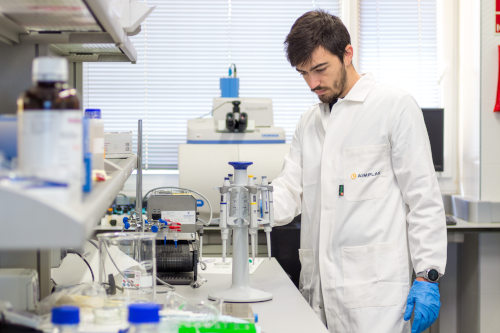
AIMPLAS's role in the project involves the pretreatment of the plastics through microwave-assisted thermal degradation, supercritical CO2-assisted depolymerization, and reactive extrusion to facilitate enzymatic and microbial action. AIMPLAS is also responsible for coordinating the dissemination and exploitation of results, as well as communication activities.
Consortium and Funding
The BioICEP project is funded by the European Union under the H2020 program, topic CE-BIOTEC-05-2019 “Microorganism communities for plastic bio-degradation”, agreement number 870292 and, in addition to AIMPLAS, involves thirteen partners from nine European and Asian countries: ACTECO (Spain), AVECOM (Belgium), TECHNISCHE UNIVERSITAT CLAUSTHAL (Germany), INSTITUT ZA MOLEKULARNU GENETIKU I GENETICKO INZENJERSTVO (Serbia), INSTITUTO DE BIOLOGIA EXPERIMENTAL E TECNOLOGICA and LOGOPLASTE INNOVATION LAB LDA (Portugal), ATHLONE INSTITUTE OF TECHNOLOGY, LIMERICK INSTITUTE OF TECHNOLOGY and THE PROVOST, FELLOWS, FOUNDATION SCHOLARS & THE OTHER MEMBERS OF BOARD OF THE COLLEGE OF THE HOLY & UNDIVIDED TRINITY OF QUEEN ELIZABETH NEAR DUBLIN (Ireland), MICROLIFE SOLUTIONS BV (Netherlands), NATIONAL TECHNICAL UNIVERSITY OF ATHENS – NTUA (Greece) and BEIJING INSTITUTE OF TECHNOLOGY, INSTITUTE OF MICROBIOLOGY – CHINESE ACADEMY OF SCIENCES and SHANDONG UNIVERSITY (China).







