




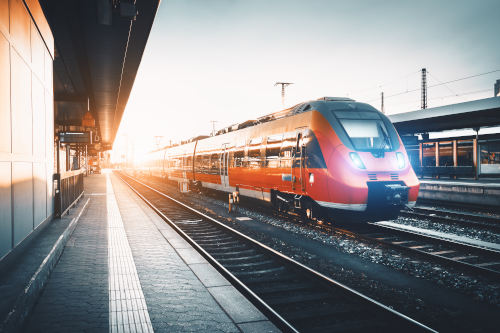
Within the framework of the project, “innovative and versatile molds and tooling are being designed and developed that will give way to a new generation of body shells using composite materials to achieve significantly lighter vehicles,” so that they can “carry more passengers within the same axle load limits, use less energy and have a reduced impact on railway infrastructure,” explains María Eugenia Rodríguez, director of the Composite Materials Unit at Eurecat.
In this regard, “an important step is intelligent design where different mold manufacturing technologies are combined, allowing us to generate tooling for forming composites efficiently, thus reducing manufacturing time and achieving a competitive cost,” he states.
Other steps planned in the project “will be the design of the train's interior floor, the development of an interior configurator with virtual reality and printed electrical circuits that save weight,” adds Laia Garriga, Head of Railway and Logistics Business Development at Eurecat.
In this regard, work is underway on a new concept of innovative doors, aimed at “creating new lightweight composite material structures to improve energy consumption, noise and thermal transmission and include improved access for people with reduced mobility,” explains Garriga.
New modular concepts for train interiors are also being developed that “will allow operators to adapt the vehicle layout to real-world usage conditions, and will improve passenger flows, optimizing both vehicle capacity and dwell times,” highlights the head of Railway Business Development and Logistics at the technology center.
Eurecat's Composite Materials Unit leads the project, and the Advanced Manufacturing Systems, Product Development, Functional Printing and Integrated Devices, Audiovisual Technologies, Big Data & Data Science and Consulting Units participate across departments.
CARBODIN has been selected in the European call for Shift2Rail, the initiative for the development of advanced research projects and solutions for European rail transport, within the European Commission's Horizon 2020 program, and has a budget of 3.3 million euros.
The CARBODIN consortium comprises 14 partners from seven European countries: Spain, Greece, Germany, Italy, France, Poland, and the Czech Republic. Along with Eurecat, the participating companies are MASATS, Composites Aragón, CADM-Automotive Group, SMT, CG Rail, and VUZ; the research centers EURNEX, EKETA, and AIMEN; the universities RWTH Aachen University, Sapienza University of Rome, and Université Polytechnique Hauts-de-France; and the railway association UIC.
For their part, In-Move by RailGrup, the Cluster of Companies for Mobility and Multimodal Logistics, and ERCI, the European Railway Clusters Initiative, support the project to enhance the dissemination of results.
Eurecat will also collaborate on a second project, led by the International Union of Public Transport (UITP), funded with 2.9 million euros and with an excussion period of 30 months.







