Although the price has stabilized somewhat, in October 2022 it was still 2.4 times higher than between 2013 and 2020. While some automakers have alternative engine technologies that do not rely on rare earths, the market has not shifted significantly in this direction; why is this?
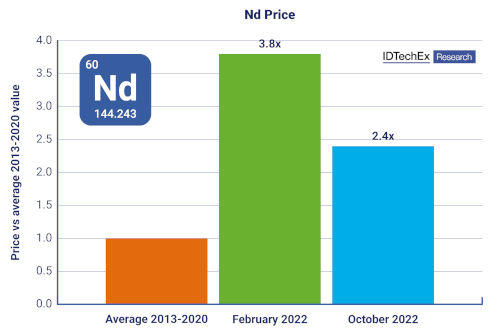 At its peak in 2022, the price of neodymium was 3.8 times the average price between 2013 and 2020. Source: IDTechEx - "Electric Motors for Electric Vehicles 2022-2032"
What are the technological options for the engines?
IDTechEx has conducted extensive research on the electric motor market for electric vehicles, including analysis, benchmarking, and demand forecasts for various motor technologies in its report, "Electric Motors for Electric Vehicles 2022-2032." To date, the three main categories used in the electric car market are permanent magnet motors, induction motors, and wound-rotor motors. From a materials perspective, each typically uses a fixed stator with copper coils; the difference lies in the rotor construction. Permanent magnet motors, as the name suggests, use magnets in the rotor that are usually made of rare-earth metals, with neodymium being the most common (although some advancements have been made in ferrite magnets). Induction motors use a copper cage or coils in the rotor and operate on an asynchronous principle. Finally, wound-rotor motors also have copper coils in the rotor, but they are directly excited by an electric current.
There are other motor technologies, such as switched reluctance motors, that have been developed to suit passenger vehicle applications, but so far the market has been dominated by the three options above.
What is happening in the electric vehicle market?
Permanent magnet motors are by far the most widely used electric motors in the electric vehicle market thanks to their high power density, torque density, and efficiency. In 2021, permanent magnet motors accounted for 84% of the electric car market. Despite their use in early Tesla vehicles, induction motors have largely been relegated to secondary drive motors due to minimal drag losses when not in use. Wound rotor motors are the typical choice when a primary drive motor without permanent magnets is required. Wound rotor options have been used by Renault and were recently adopted by BMW for its fifth-generation motor.
With rising material costs, particularly for expensive rare earth elements, there has been a growing interest in phasing out their use in electric motors. As mentioned earlier, BMW and Renault have used wound-rotor motors, and Mercedes opted for induction motors for its EQC model. Established motor suppliers, such as MAHLE, and smaller companies, such as Advanced Electric Machines, are also focusing on magnet-free alternatives. Despite this interest, the market share of permanent magnet motors for the first half of 2022 actually increased to 86%, up from 84% in 2021.
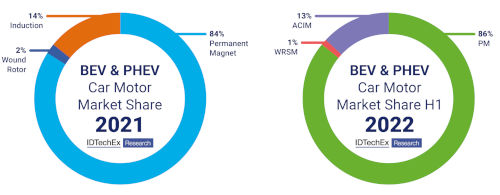
The market share of permanent magnet motors grew slightly in 2022. Source: IDTechEx
Why hasn't the market abandoned rare earth elements?
There are several reasons why permanent magnet motors have remained the dominant technology choice in 2022 so far. The first is China's dominance of the domestic electric vehicle market. The Chinese EV market is the largest in the world, and China is also responsible for the vast majority of rare earth supply, so the cost of neodymium is not as much of a concern as in other regions. Another potential reason is automotive development timelines; vehicle platforms that will be sold in 2022 will have been developed over several years, with existing contracts for motor supply. There will be a lag between market interest in magnetless motors and their actual deployment on the road. Alternative motor technologies will also require expertise and development; original equipment manufacturers (OEMs) are comfortable with permanent magnet motors, and a technology shift needs to demonstrate reliability, equivalent or better performance, and that it doesn't require significant changes to the control electronics (unless these can be integrated with the motor).
Electric Motor Market Outlook:
Despite rising costs for rare earth elements and other materials, IDTechEx anticipates that the majority of the electric vehicle market will continue to rely on permanent magnet motors in the short to medium term, particularly in China, which accounts for the largest share of the electric vehicle market. Europe is the key region where we can expect greater adoption of magnet-free technologies, as already demonstrated by Renault, BMW, and Mercedes. In a few years, with the next generation of vehicle platforms, we expect to see further announcements regarding magnet-free options.