The rebound is not uniform; growth varies significantly across EU countries and product groups. However, something has shifted in the mindset of decision-makers: there is renewed momentum, accompanied by a greater awareness of interdependencies and the need to strengthen resilience and security. At the same time, optimism is growing that the economic winter may be coming to an end.
Semiconductors (Q4)
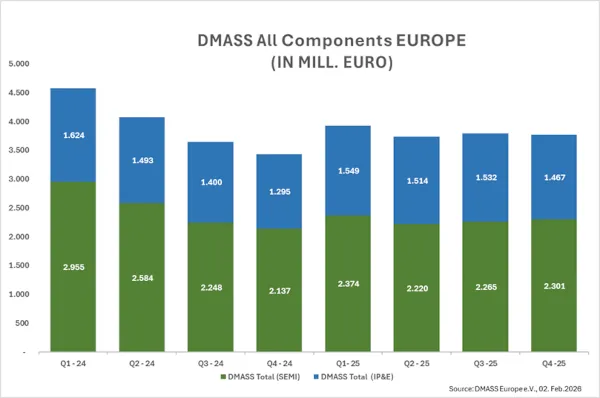
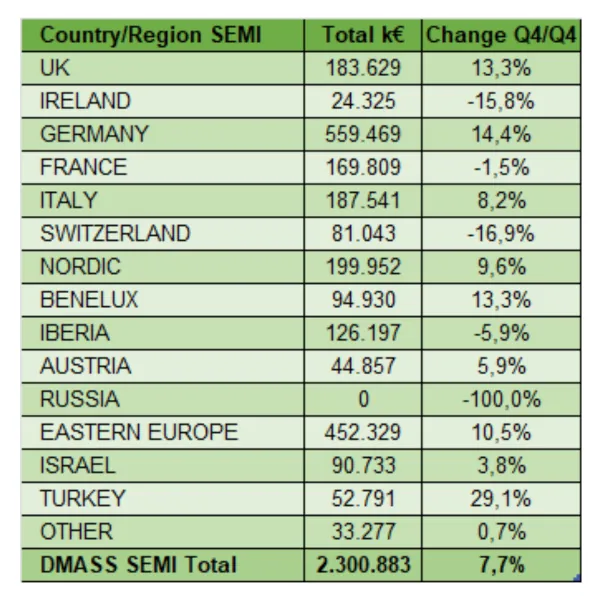
European semiconductor distribution strengthened markedly in the last quarter of 2025, reaching sales of €2.3 billion (+7.7%) year-on-year. Although the overall trend is positive, the recovery remains uneven: Switzerland (-16.9%), Ireland (-15.8%), the Iberian Peninsula (-5.8%), and France (-1.5%) continued to register year-on-year declines.
In contrast, Turkey (+29.1%), Germany (+14.4%), Benelux (+13.3%), and the United Kingdom (+13.3%) showed the strongest growth, indicating robust activity in several key markets. The sector is clearly regaining confidence, despite persistent structural imbalances in Europe.
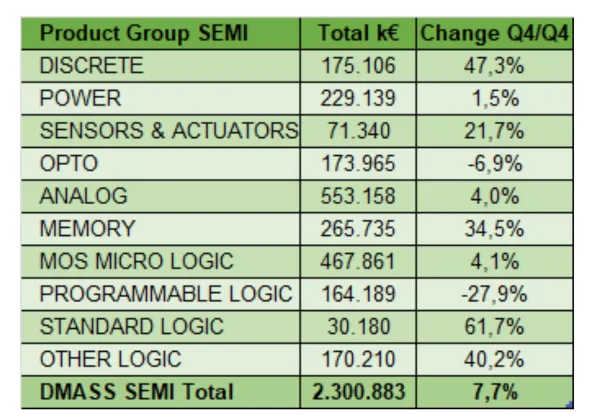
By product type, Programmable Logic (-27.9%) and OPTO (-6.9%) registered the worst sales results. In contrast, Standard Logic (+61.7%), Other Logic (+40.2%), Memories (+34.5%), and Sensors and Actuators (+21.7%) significantly outperformed the market average of +7.7%, demonstrating remarkable growth.
Interconnection, Passive, and Electromechanical Components (Q4)
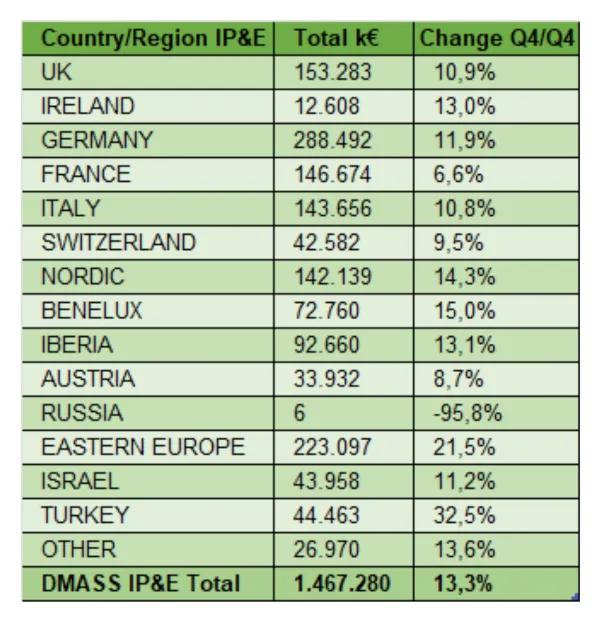
In the IP&E segment, the momentum from the third quarter continued into the fourth, with a solid increase of +13.3% and revenues of €1,470 million. Growth was driven by strong regional results, led by Turkey (+32.5%), Eastern Europe (+21.5%), and Benelux (+15.0%), reflecting solid underlying demand.
France (+6.6%), Austria (+8.7%), and Switzerland (+9.5%) posted single-digit increases, indicating a more moderate recovery. Germany, meanwhile, weighed down the overall average for the IP&E segment, despite showing relatively better results in semiconductors, underscoring the uneven nature of the recovery across markets and product categories.
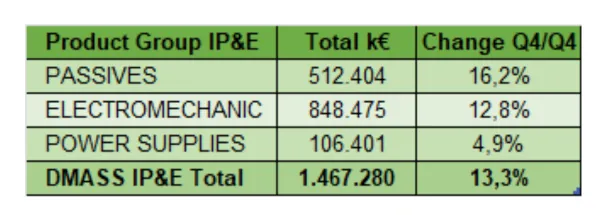
By product category, passive components (+16.2%) showed a solid recovery, while electromechanical components (+12.8%) performed particularly well. Power supplies (+4.9%) were impacted by the sharp decline in batteries and accumulators (-13.2%), while AC/DC converters registered only a slight increase of +2.2%.
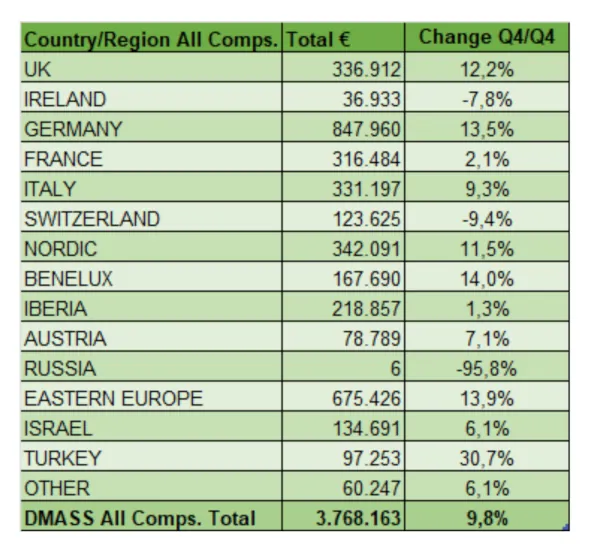
All components consolidated by region (Q4):
Statements by President Hermann Reiter:
The encouraging figures of the last few quarters should not lead us to erroneous conclusions. Year-on-year comparisons appear robust largely because the previous base was exceptionally weak. In recent years, Europe has lost global market share as the electronics boom has concentrated in the AI hubs of the United States and Asia.
Against this backdrop, European growth may appear modest, but it is steady, reliable, and rooted in the industrial transformation that is now beginning to take shape.
Europe is growing broadly, though not uniformly, and this diversity is a strategic asset. History shows that our industrial applications tend to offer longer lifecycles, greater reliability, and greater sustainability. Therein lies the true strength of European development: in a solid industrial base, long-term planning horizons, and the stability provided by mature democratic structures.
The environment remains demanding: commodity volatility, AI-driven disruption, and rising demand in the aerospace and defense sectors create both pressure and opportunities. Government initiatives often shine brighter in their promises than in their execution. Even so, Europe has demonstrated its resilience in the face of adversity in the past. The challenges are real, but so is our determination.