
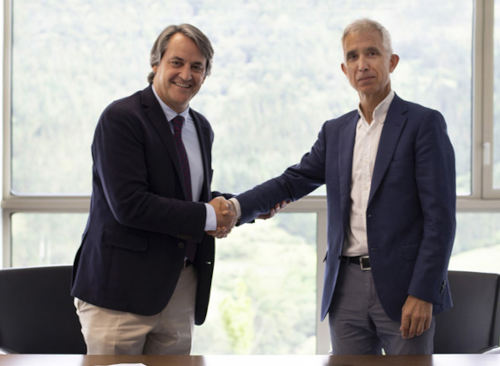
“We are committed to maintaining long-term collaborations like this, because they allow us to contribute to the growth of the Basque industrial fabric and, at the same time, expand our knowledge in the sector to scale the solutions to other projects,” Uriarte emphasized.
The lines of work will continue the work carried out previously within the framework of the collaboration, with the design of new machining solutions that can perform different processes (milling, turning, drilling and grinding), that optimize their workshop space, that can be transported and maintained without special requirements, that are more precise and that meet the zero defects strategy with a lower environmental impact.
“Having a partner like Tekniker is key to addressing the improvement of our products and services, and to advancing in the multifunction, stability, precision and dynamics of the machines, giving them greater intelligence,” highlighted Fernando Arocena.
Cutting-edge technology:
The new solutions that Zayer and Tekniker will jointly research will aim, on the one hand, to further improve the machines' resilience to thermal variations. To this end, equipment will be developed using the latest technology in thermal drive control, enabling different control strategies to minimize the minor errors caused by these variations.
Zayer and Tekniker will also work on different strategies to improve the rigidity, dynamics and precision of the machines to meet the requirements of productivity, geometric accuracy and finish quality.
Another line of action involves developing systems for the rapid characterization of machine volumetric accuracy, enabling quick and accurate measurement across the entire work volume. Further research will be conducted into technologies for verifying machines with unprecedented precision and speed, implementing new self-calibration solutions and reducing setup times.
The ability to perform automated measurements directly on the machine and assign uncertainty to these measurements is one of Tekniker's priority areas. This allows metrology to move beyond being an activity performed only at the end of manufacturing and be implemented at intermediate stages of production, enabling in-process measurements and thus advancing the zero-defect strategy.
Finally, the agreement includes the research and development of new multifunction systems to enable several machining processes on the same machine, which presents numerous technical challenges. These systems allow a single part to be finished on the same machine, with the resulting advantages in terms of efficiency and energy savings.