
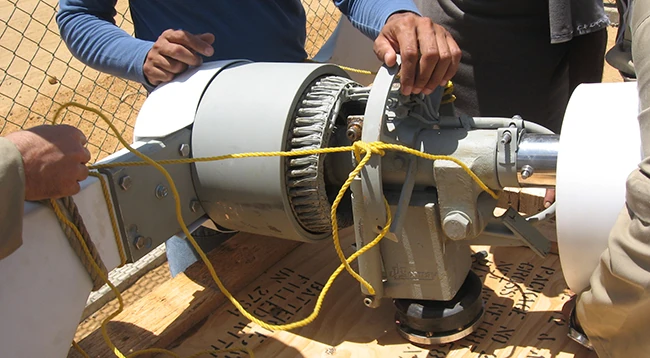
The equipment needed for the installations was delivered during January and February 2010 for subsequent installation at the selected sites.
The project included 48 hybrid wind-solar photovoltaic systems with diesel backup, sized to supply communities of 10, 20, 30, or 40 homes. The installations combined different generation and storage sources to provide a stable electricity supply and adapt to the energy needs of each community.
A microgrid for communities without access to the electrical grid.
The systems operated using SMA Sunny Island units connected to 48-volt battery banks. These units formed an alternating current microgrid responsible for distributing electricity to the homes.
The system prioritized electricity from wind and solar photovoltaic sources. When production exceeded consumption, the available energy could be stored in the batteries. During periods when renewable generation and stored energy were insufficient to meet demand, a backup diesel generator was used.
Project Characteristics:
The project had an approximate value of two million euros and included the supply of 155 SI5048 inverters, 126 SB3300 inverters, 24 Bornay 3000 wind turbines, and 72 Bornay 6000 wind turbines, in addition to other components and accessories necessary for the installations.
The configuration of these systems allowed for the combination of wind and photovoltaic generation, battery storage, and diesel backup generation. In this way, the installations could take advantage of available renewable resources and resort to an auxiliary source when generation conditions or battery charge levels required it.
Electrification of Isolated Areas:
The project developed in Venezuela is an example of the application of hybrid systems for the electrification of small communities far from conventional power grids.
This type of installation allows for a local microgrid based primarily on renewable energy sources, complemented by storage and backup generation. Its design can be adapted to the size of each community, its electricity demand, and the energy resources available at each location.