




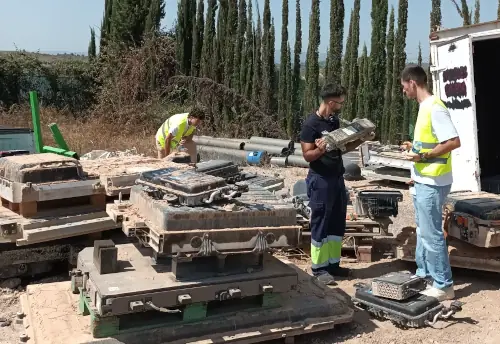
In this context, RECRIT-CV emerges, a Valencian research project that seeks to transform end-of-life lithium-ion batteries and electronic waste into a new source of raw materials for industry. The initiative will develop advanced technologies to sustainably recover critical metals present in batteries and printed circuit boards, and reintroduce them into the production chain with sufficient quality to manufacture new batteries, electronic components, or ceramic pigments.
RECRIT-CV aims to demonstrate the feasibility of locally processing technological waste to obtain critical raw materials with purity and performance comparable to virgin materials. This will be achieved through the development and application of sustainable technologies and conditions that guarantee technically viable, economically profitable, and environmentally responsible processes.
The Valencian technology centers ITE (Energy Technology Center), AIDIMME (Metalworking Technology Institute), AIMPLAS (Plastics Technology Institute), and ITC (Ceramic Technology Institute) are collaborating on this research project, which is funded by IVACE+i and the European Union's ERDF funds.
RECRIT-CV aligns with Regulation (EU) 2023/1542 on batteries and Regulation (EU) 2024/1252 of the European Parliament and of the Council, which establishes a framework to ensure the secure and sustainable supply of critical raw materials. These regulations mandate increased recycling, higher recycled content in new batteries, and a reduction in the European Union's heavy reliance on raw materials from third countries.
Although the underlying technology is complex, the project has been designed with a very practical approach. In the first phase, the teams will develop systems to identify and disassemble batteries and PCB components, safely and automatically separating their different parts. The goal is to obtain, on the one hand, concentrated mixtures of the batteries' active material and, on the other, the cleanest possible fractions of metals and plastics, as well as valuable components from the electronic boards, such as copper and rare earth elements.
Advanced Hydrometallurgy and Recycling:
From there, advanced hydrometallurgy strategies (including chemical and electrochemical processes) and direct recycling will be applied to extract the most valuable metals, such as lithium, nickel, manganese, cobalt, and copper, among others.
In a third stage, the recovered metals will be purified to the quality required by industry and tested in real-world applications. These metals will be used to manufacture, for example, new battery materials that will be tested in prototype cells, pigments for the ceramics industry, and conductive coatings for electronic components.
RECRIT-CV aims to achieve recoveries of 80 percent or higher for lithium, nickel, manganese, cobalt, and key rare earth elements such as neodymium, praseodymium, and dysprosium, and around 70-80 percent recovery for copper, gold, and silver. In terms of quality, the goal is to achieve purities exceeding 95 percent for most recovered metals and surpassing 98 percent for certain products, such as some oxides used in ceramic pigments.
Beyond laboratory testing, the project includes a validation phase in relevant environments, pilot facilities, and in collaboration with companies in the Valencian Community dedicated to waste management, recycling, battery manufacturing, and other related sectors. The goal is for the solutions to demonstrate their technical and economic viability and be ready for industrial scaling.
“The project aims to position the Valencian Community as a leading hub for advanced battery and electronic waste recycling and the recovery of critical raw materials, an area poised for sustained growth in the coming years,” says Iván Esteve, project manager at ITE.







