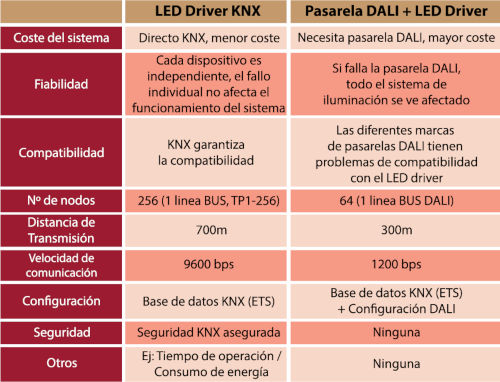
 Another approach to building automation, similar to DALI, is the use of KNX lighting, which originated in Europe and is headquartered in Brussels. Devices from different manufacturers can interact and function seamlessly because all products undergo rigorous testing by a neutral testing laboratory to ensure interoperability. Table 1 is a comparison chart between KNX and DALI, showing how the KNX system outperforms DALI.
Table 1: KNX Direct Lighting System (left) vs. KNX System with DALI (right)
Minimum Dimming Level:
The human eye does not perceive changes in light level linearly, and slight variations in perception occur between individuals. This response results in a difference between the measured and perceived light levels shown in Figure 1.
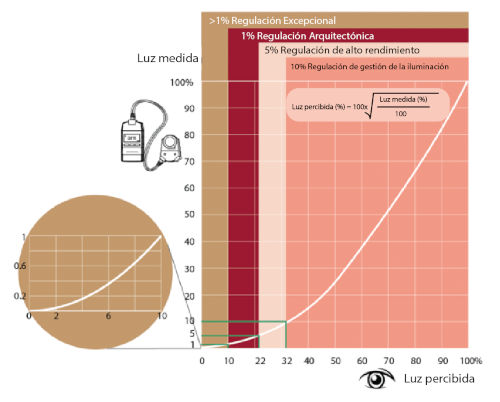 Figure 1: Perceived Light vs. Measured Light. Source: IESNA Lighting Handbook, 9th Edition with modification.
There are three dimming curves to observe: linear, DALI, and the MEAN WELL PWM-KN driver's ETS application database log. The linear curve provides the driver output as the command sent from the button. The DALI curve is based on the formula specified in the DALI standard, which provides the user with an excellent dimming experience. This is because the light difference between steps is designed to be constant, and the minimum dimming level is 0.1% (equivalent to 3% perceived light) according to the DALI standard. The log curve provides the logarithmic response. It's worth noting that the minimum output of the logarithmic curve provides only 0.01% (equivalent to 1% perceived light), which opens up possibilities for some applications where low luminescence is required. The user is free to select one of these three curves to achieve the best result.
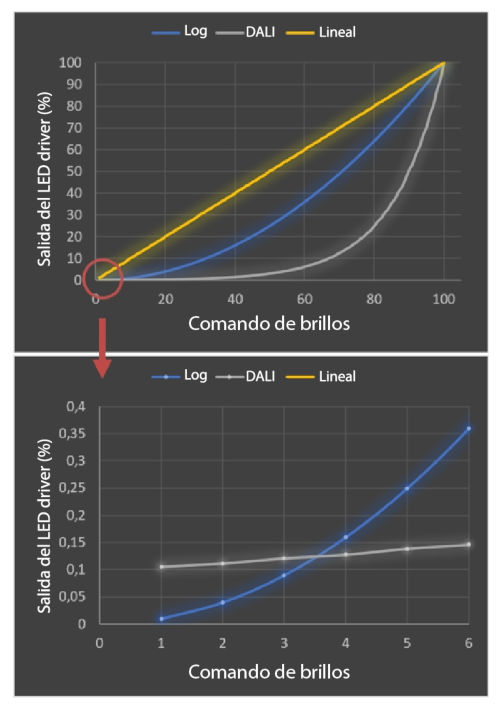 Figure 2 Three selectable dimming curves for the MEAN WELL PWM-KN driver.
The dimming performance test carried out using the 24V LED strip is shown in Figure 3. It shows that low light intensity is achieved by using the Log curve of the MEAN WELL PWM-KN driver, which gives a better result than the DALI driver. It is suitable for some applications where very low light intensity is required (e.g., for cinemas).
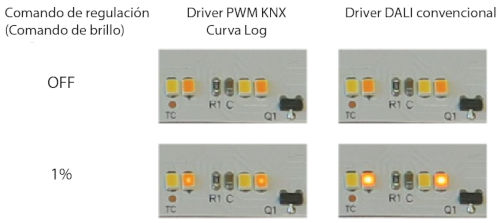 Figure 3 Regulation performance test result: 0.01% (left) vs. 0.1% (right) KNX and DALI driver output respectively from the same regulation command.
Constant voltage LED lamp regulation is generally achieved using PWM (pulse width modulation), adjusting the current duty cycle, which results in changes in the average current. PWM is effective for the precise light dimming requirements of handling high dimming ratios at a higher frequency to avoid light flicker and strobing while maintaining minimal effects on the LED's color temperature. DALI LED drivers have a fixed output frequency of several hundred hertz, depending on the manufacturer's design. A higher frequency design is preferred, however, but this compromises product reliability because more switching losses occur in the driver component. The MEAN WELL KNX PWM driver has a unique design, and the output frequency can be adjusted by the user between 200 Hz and 4000 Hz. It avoids frequencies below 80 Hz, at which the human eye detects visible flicker. Meanwhile, the 4000Hz PWM frequency satisfies not only the IEEE 1789-2015 standard, which was set at 3000Hz, but also the SVM (stroboscopic visibility measurement) for the new Eco-design, which will take effect on September 1, 2021, in the European market. The SVM formula gives the summarized weighted spectrum for all frequency components up to 2000Hz, meaning that 4000Hz PWM meets these requirements.
Where Ci is the relative amplitude of the i-th Fourier component; Ti is the visibility threshold for the stroboscopic effect of a sine wave at the frequency of the i-th Fourier component.
Equation 1: Formula for the Eco-design stroboscopic visibility measurement requirement in effect from September 1, 2021.
Use of the KNX constant voltage LED driver:
We present the four applications for using these LED drivers. First, for LED strips (the most common). Secondly, it's suitable for traditional 12V AC lamps, but with LED technology. It's also compatible with commercially available 24V DC LED lamps. Finally, an additional DC/DC converter can be used to control the constant current LED lamp. We'll discuss the use of LED strips first.
After ETS programming, the controller is placed in its final location, and the LED strip is connected to the driver's output. The KNX cable is then connected for telegram reception, followed by a connection to the 230V AC mains. When the driver receives a command from a button or any other KNX input device, the light is controlled to turn on, off, or dim.
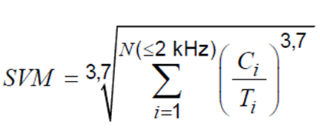 Figure 4 shows an LED strip.
The second application is using a 12V AC LED lamp for spot lighting. The benefits are: replacement of the low-voltage halogen lamp, meaning even the end user could replace it without safety concerns; long lifespan; and dimming options. The conventional way to control these lamps in a KNX system is to use a phase-cut dimmer along with an electronic transformer. Such a system is complex and expensive. We would like to propose a new approach for using these LED lamps with the MEAN WELL KN PWM series.
The connection is very simple. Even better, several lamps can be connected in parallel. Note that you only need to program the on/off function of the controller if you are using non-dimmable lamps. Non-dimmable lamps have a symbol that is shown on the packaging or described in the lamp's datasheet. For dimmable lamps, the controller can be programmed to perform on/off and dimming functions. The dimming range also depends on the type of lamp, and the user can adjust the driver for optimal performance using the ETS software.
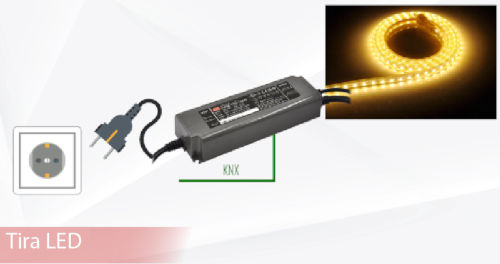 Figure 5 Traditional Method: 12V AC LED (left); KNX Direct Drive Method (right)
The third application is using a 24V DC LED luminaire for spot lighting. The benefits are similar to the 12V AC methods described above, except that the voltage is 24V DC, resulting in less electrical loss along the cable. You can use a 24V DC LED driver to perform on/off and dimming functions. Several luminaires can also be connected in parallel.
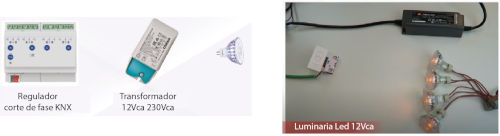 Figure 6 KNX LED driver with 24VDC LED luminaires.
The final application is the use of a constant current LED module or lamp, which requires an additional DC/DC converter between the constant voltage driver and the LED. MEAN WELL offers the LDD, LDB, and LDH series for this purpose, depending on whether step-up or step-down mode is required. Multiple lamps can also be connected in parallel.
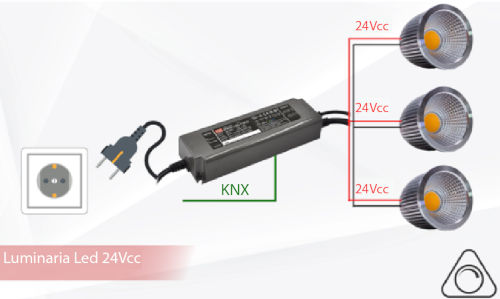 Figure 7 KNX Driver for use with constant current LED panels + DC/DC Converter
Conclusion:
This article describes how the KNX lighting system is superior to DALI, and how much more can be achieved with a constant voltage KNX driver. The MEAN WELL PWM-KN series constant voltage LED driver is a perfect solution, not only avoiding the incompatibility between the DALI gateway and the driver, but also providing many more features that benefit the lighting system. Furthermore, the system is simplified by eliminating the need for a transformer, as is traditionally the case, resulting in reduced costs.
Author: Wen Wu, MWEU Product Manager