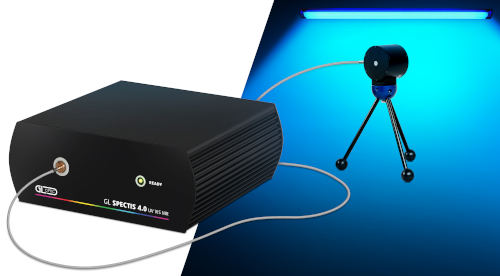
The coronavirus pandemic has created a surge in demand for UV lamps and systems for decontaminating entire rooms, which were previously used exclusively for sterilizing medical devices. GL Optic offers the technical expertise and radiometers necessary to carry out these disinfections effectively and safely.
However, the use of UV lamps and systems requires precise measurements to quantify and validate their effectiveness. This allows for the development of specific products and solutions for offices, classrooms, restaurants, gyms, and other spaces where many people gather and spend time. GL Optic can illustrate how the properties of UV disinfection lamps should be verified and what factors should be considered when choosing a UV system to ensure the right conditions for effective disinfection.
Irradiance Measurements:
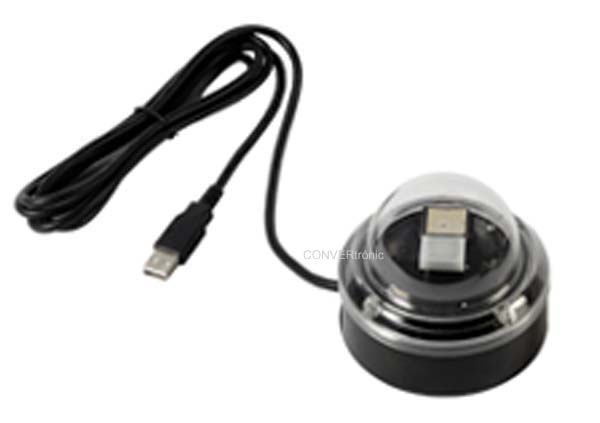
One method for validating UV-C lamps is irradiance measurement. The simplest device for these measurements is a UV radiometer with a measuring head set to a wavelength of 200 to 280 nm. Special attention must be paid to the sensitivity range of the measuring instrument, which must also be within appropriate limits. For disinfection lamps to be used in complex installations and not just as fixed emitters, goniometric measurement of the lamp's radial flux, which radiates in various directions, is essential.
Effective disinfection requires an appropriate dose. An
appropriate dose is defined as the UV radiation power in [W] incident on a given surface [m²]that depends on the virus's exposure time in [s] to deactivate its RNA. This dose is calculated as the essential irradiance [W/m²] per unit of time [s] and is expressed in J/m²( mJ/cm²).
GL Optic offers solutions and approaches for the measurement and calculation process, the presentation of radiometric data and values, and suitable measuring instruments, such as radiometers, along with software for simulating the distribution of radiant intensity on the surface of the selected room.