
There are various types of wireless communication (WiFi, ZigBee, Bluetooth, Z-wave, EnOcean, etc.) whose main characteristics are reflected in the following table: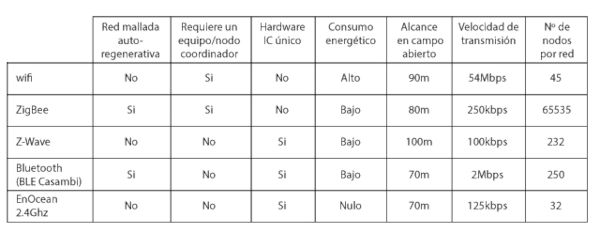
The advantage of a mesh network is that a command intended for one luminaire can be relayed between luminaires until it reaches its destination (e.g., the destination luminaire does not need to be within range of the push button that generates the command), extending the signal's range and ensuring complete coverage of the area to be controlled. This feature is especially useful in large lighting applications, such as office buildings or warehouses. The self-healing property allows the network to establish alternative communication paths without requiring installer intervention (for example, if one of the luminaires in the network fails). Some systems require certain points to be assigned an additional coordinator or link node function. If a coordinator fails and the network is not self-healing, communication problems may arise that require technician intervention. Systems based on a single type of hardware allow for automatic updates. Systems that use different types of hardware (microcontroller, radio module) don't always allow for automatic updates or guarantee optimal interoperability between devices from different manufacturers, since each manufacturer may use different radio modules with varying characteristics and performance (e.g., the network's communication speed will be limited by the slowest module).
Taking all this into account, we opted to use a Casambi BLE network for the comparison. The Casambi BLE system has been adopted by many manufacturers, although many of them use it under different brand names.
Casambi networks also have the advantage of being able to coexist with an existing wired DALI installation (Casambi devices can be controlled from a DALI control unit, DALI pushbuttons, etc.), although in the example installation we are discussing, we will not be using this functionality. Another advantage is its compatibility with EnOcean 2.4GHz pushbuttons and sensors (with zero power consumption).
EnOcean technology is known for its innovative approach to self-powered, battery-free energy. EnOcean devices harness ambient energy sources, such as sunlight, vibration, or temperature differences, to generate the electricity needed for their operation.
EnOcean pushbuttons are surface-mounted and require no cables or batteries to operate. Instead, they harness the energy generated by the user's mechanical pressure when pressing the buttons. This energy is used to transmit a wireless signal that allows control of the installation's luminaires.
This type of pushbutton enables convenient wireless lighting control. Users can place them anywhere they want, without the need for wiring, junction boxes, or complex installations. This provides great flexibility in the placement of the pushbuttons and allows for quick and easy customization and adaptation of the lighting configuration.
LIGHTING RENOVATION IN A TWO-STORY HOUSE
The objective of the renovation is to provide regulation to all the ceiling lamps in the house, except those in the bathrooms.
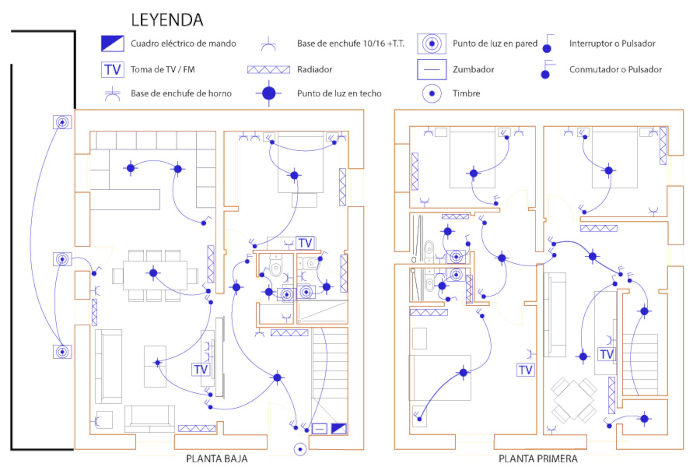
A quote was requested from an electrician for implementing control using DALI equipment and pushbuttons, and another quote was also requested for implementation using Casambi BLE equipment and EnOcean pushbuttons.
The result is shown below:
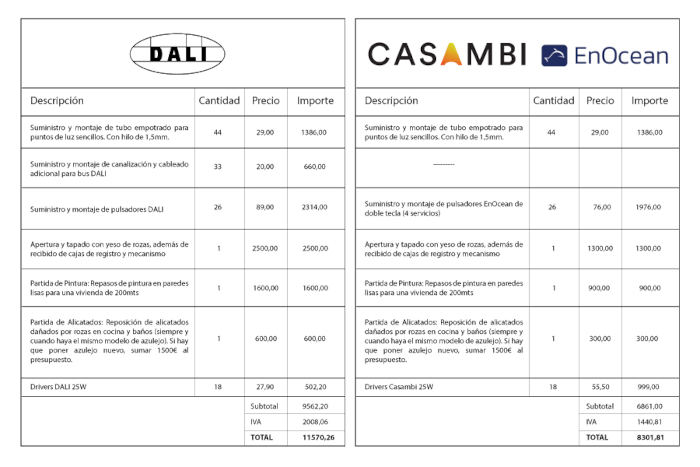
The use of Casambi also allows control via mobile phone and the creation of scenes by the user without requiring the services of a DALI programmer.
The use of dual-function pushbuttons (four functions) has been planned so that one pushbutton will not only serve to turn on, turn off, and adjust, but will also have two additional free functions that could be used to activate scenes, for example.
When installing or upgrading a lighting system, cost savings are a key consideration. Comparing Bluetooth devices and EnOcean switches with DALI devices and wired DALI switches reveals several areas where significant savings can be achieved:
a) Installation costs: Using Bluetooth devices and EnOcean switches eliminates the need for wiring infrastructure. This results in considerable savings in labor and materials related to cable installation. In contrast, using DALI devices with wired DALI switches requires a wired installation, which involves a higher initial cost.
b) Material costs: Eliminating cables in Bluetooth + EnOcean systems also reduces costs associated with purchasing cables and connectors. Furthermore, battery-free EnOcean devices eliminate the need for battery replacements over time, reducing maintenance costs and the need to purchase spare batteries.
c) Flexibility and ease of configuration: Bluetooth and EnOcean-based systems offer greater flexibility and ease of configuration compared to wired DALI systems. The wireless capability of Bluetooth and EnOcean devices allows for quick changes and adjustments to the lighting configuration without requiring physical intervention in the existing wiring. This reduces the costs associated with modifications, expansions, and reconfigurations after the initial installation.
As can be seen in the practical example shown in Figure XX, the use of Casambi BLE (Bluetooth Low Energy) controlled devicesand EnOcean pushbuttons eliminates the need for chasing walls and running conduits and cables to the switches in the home. It also avoids the conduits and wiring of the DALI bus. This results in lower labor costs for electrical work, masonry, and painting.
In short, using Bluetooth devices and EnOcean switches when renovating a lighting system can generate significant savings in installation, material, and maintenance costs compared to using DALI devices with wired DALI switches. The elimination of wiring and the low power consumption of Bluetooth and EnOcean technologies contribute to a faster, more flexible, and more efficient installation.
When considering subsequent maintenance, the Casambi system, in particular, also has an advantage over wired and other wireless systems: Each Casambi device stores its own configuration, as well as the configurations of all other devices on the same network, in its non-volatile memory. This allows for the replacement of a faulty device with a new one without having to reprogram groups, scenes, etc. Using the app's "Replace Device" function, the other devices automatically send the original configuration parameters to the new device.
We can conclude that the use of wireless control systems already represents a cost saving compared to wired bus control, in addition to enabling advanced functions.
Aware of this trend toward wireless control, organizations like DALI and KNX are also developing their own radio control alternatives. This is the case with DALI+ and KNX RF.
There are also other emerging wireless control protocols such as Thread (backed by Google and Apple, among others), although the standardization and adoption of a single wireless lighting control system seems unlikely in the short term.
Authors: Jose Leandro Espada and Adrián Garcés Clemente / R&D of OLFER Electronics