

 One of the advantages of LEDs is their ability to be dimmed by regulating the current they consume. However, LED strips are designed to be cut at regular intervals, simplifying installation and eliminating the need to choose a specific strip length. This versatility is a drawback, as they are designed to be cut internally with several LEDs in series with a resistor to limit the current. These resistors form the blocks or sections that can be cut. These sections are then connected in parallel with the rest of the blocks. This means that a resistor limits and controls the current entering the LEDs, which is why they operate at constant voltage, not constant current, to facilitate assembly and installation. Simply choose a power supply with the appropriate voltage and sufficient power to supply the required strip length. This means that LED strips do not operate in constant current and cannot be dimmed in the same way as most dimmable power supplies. If we want to use a standard dimmable power supply with an LED strip, we must choose a power supply wattage that matches the current draw of the strip. This means that the advantage of using any power supply is no longer useful if we want to dim the strip. In an installation, it's impractical to carry different power supply models depending on the length of the strip. In many cases, installations are improvised by cutting the strips as needed. If we use a conventional dimmable power supply with a much higher wattage, when we tell the power supply to reduce the maximum output current, since the current it delivers is lower than its nominal rating, it won't do anything. Therefore, we might find that three-quarters of the dimming cycle is ineffective. Furthermore, due to the voltage drop across the current-limiting resistor at low brightness levels, we're likely to experience flickering or the strip may turn off when its brightness drops below 50%.
The human eye is more sensitive to low light levels, which means that when we adjust the brightness of a light strip, we initially barely perceive that we are lowering the light level, even though we are significantly reducing energy consumption. Therefore, in many applications, especially if we want to create relaxing environments with low light levels, it is not possible to achieve this with a standard light source.
To solve this, PWM controllers are used, which essentially slice the power supply output. This is like turning the strip on and off very rapidly; the human eye doesn't perceive the switching off because it happens so quickly, just as we don't perceive the frame changes on a television. In this way, we can regulate the intensity of the LED strips from 0% to their maximum brightness.
Currently available on the market are regulators that operate with a 12 or 24V DC supply voltage, so we need both the regulator and a separate power supply. This increases the installation cost and takes up more space. Furthermore, the pulsating load generated by these PWM regulators often causes the power supplies to resonate in their feedback loop, which can produce very annoying audible noises—a whistling sound when regulating.
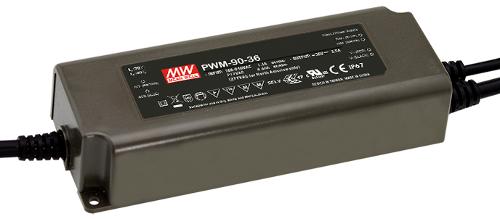
The PWM-90 series has been specially designed for this application and combines the regulator with the power supply. It has no audible noise issues because its loop is specially designed and allows regulation from 0% (off) to 100%. This makes it ideal for lighting or decorative applications with LED strips where dimming is desired. Control is achieved via a conventional 0-10V regulator (typical dimming dial) or a PWM signal. Whether using a 1 cm strip or connecting several strips of different sizes to the same power supply, the regulation is perfect in all cases. The only thing to ensure is that the maximum power allowed by the PWM-90, which is 90W, is not exceeded.
In addition to all these advantages, this power supply has a startup time of less than 0.5 seconds, no-load consumption of less than 0.5W, active power factor, low harmonic distortion, and a 5-year warranty, among other notable features.