
DMX originated as a one-way communication system between a single Master controller and slave receivers. In 2006, the optional Remote Device Management (RDM) function was introduced, which uses bidirectional communication to enable additional functions such as remotely configuring the DMX address of receivers from the master control console or monitoring their status, faults, etc.
Operation:
The DMX controller continuously sends frames of up to 512 bytes and does not require confirmation that the information has reached the receiving devices. The 512 bytes are transmitted in less than 23 ms and are retransmitted continuously. Each byte contains the information for one channel, so we can have up to 512 channels (the set of 512 channels is known as a DMX Universe).
Each channel can have a value between 0 and 255 (8 bits). This value will determine the dimming level of a light fixture, the speed of a motor, the tilt angle of a projector, etc. For example: An RGB projector will need to use three consecutive channels, since the value of each channel will define the dimming level of each color: red, green, and blue. All receivers on the DMX bus receive information from all channels, but they will only use the information from the channels assigned to them.
The way a receiver decides which channels to use is by assigning it a DMX address. The DMX address we assign implicitly defines the number of the first channel the receiver will use. For example, if we assign DMX address 012 to an RGB projector, it will only consider the information from channels 012, 013, and 014 and ignore the rest. The master controller also needs to know that there is an RGB spotlight at DMX address 012 so it can communicate the information to it through the corresponding channels.
In DMX, several receivers of the same type can have the same address. This way, they will receive the information simultaneously.
Addressing:
There are several ways to manually assign an address to a slave receiver. The most common are:
- Using DIP switches. Each microswitch has an assigned value. The sum of the activated values defines the DMX address.
- Using displays. The digits are adjusted using pushbuttons.
- Using an app such as the Light App from DALCNET or EasyNFC from INFINITUM POWER (the address is then transferred via NFC from the phone to the device).
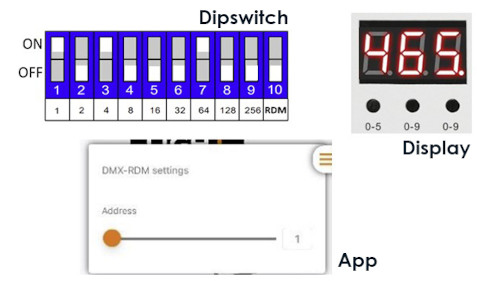
Figure 1: Manual assignment of the DMX address to a receiver.
Those RDM compatible devices can be addressed from the master or another programmer through the communication bus itself.
Installation:
There can only be one master controller on each DMX bus. The DMX bus is daisy-chain type (each device is connected to the DMX output of the previous one). It is common for slave receivers to have separate connections for DMX in and DMX out. If the receivers have a single connection for the DMX bus, they are connected in parallel. Figure 2 shows two DLX1224-4CV-DMX devices:

Figure 2: Installation.
Up to 32 consecutive units can be connected in a chain. To connect more, repeaters (boosters) must be added.
The cable must be shielded and twisted-pair, with an impedance of 120 ohms (the same type used for RS485 industrial communication). At the end of the bus and before each repeater, a 120-ohm termination resistor must be placed between DMX+ and DMX-. This resistor may already be integrated into the equipment itself. When the cable distance is very short, it can function without the resistor (although the DMX standard requires its use). The cable's shield must be grounded, but only at one end (usually the end connected to the Master Controller).
Lighting applications:
When using RGB or RGBW projectors, you'll find a wider range of models dimmable by DMX than by DALI DT8. Single-color or dynamic white luminaires, relays, and other devices can also be controlled.
It's possible to control a single luminaire or groups of luminaires using a master controller like the CasDMX (configured via Casambi Bluetooth). This allows DMX to be combined with pushbuttons, sensors, and other control protocols. There are also simple touch panels that act as masters, allowing control of multiple groups/zones. Alternatively, multiple DMX universes with thousands of lights and effects can be controlled using more advanced controllers and powerful PC software (Figure 3 above).
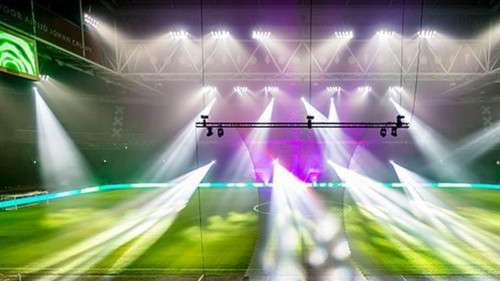
DMX is also applied to sports lighting, as the lights illuminating the playing area are now also used to create effects. For this, the LED drivers used must be capable of rapid response. For example, the manufacturer UPOWERTEK has developed LED drivers for white or RGBW light, controlled by DMX, from 320W to 2000W capable of creating effects up to 40fps (Figure 3 below).
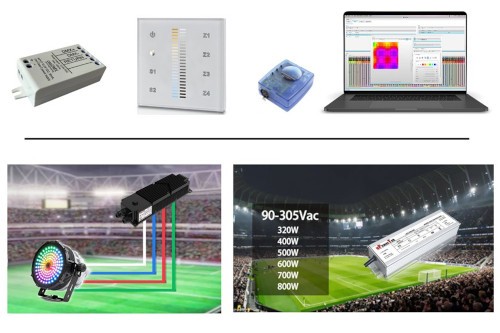
Figure 3: Control and Applications
Although DMX has traditionally been associated primarily with spectacular lighting control, it can now be easily integrated and considered a viable alternative for other applications. See the range of DMX controllers and LED drivers from Electrónica OLFER.
Author: Jose Leandro Espada / OLFER Electronics