Each LED luminaire section is equipped with a constant current source, as shown in Figure 1, to ensure the current range of each channel and extend the LED luminaire's lifespan. In most cases, a constant current source is provided by a linear integrated circuit or an LED driver with a DC input and a constant current output. Generally, the constant current source uses a constant current integrated circuit or a DC-DC LED driver. However, with the optimization of the LED manufacturing process, the reduction of the LED forward voltage difference, and the demand for high-efficiency luminaires, high-power lamps are mostly "direct-driven," as shown in Figure 2. Mobile lighting, solar streetlights, centralized power supplies, and other applications are increasingly common for DC-DC LED drivers.
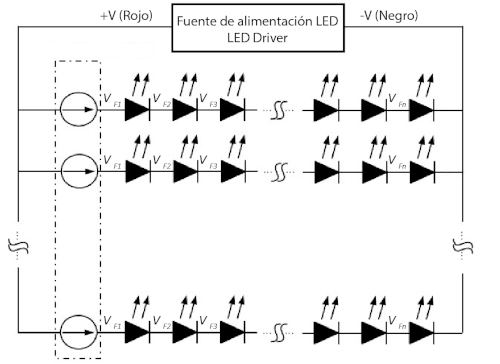 Figure 1. Constant current or constant voltage LED driver with linear integrated circuit of the LED driver.
Figure 2. The LEDs are directly controlled by the constant current LED driver.
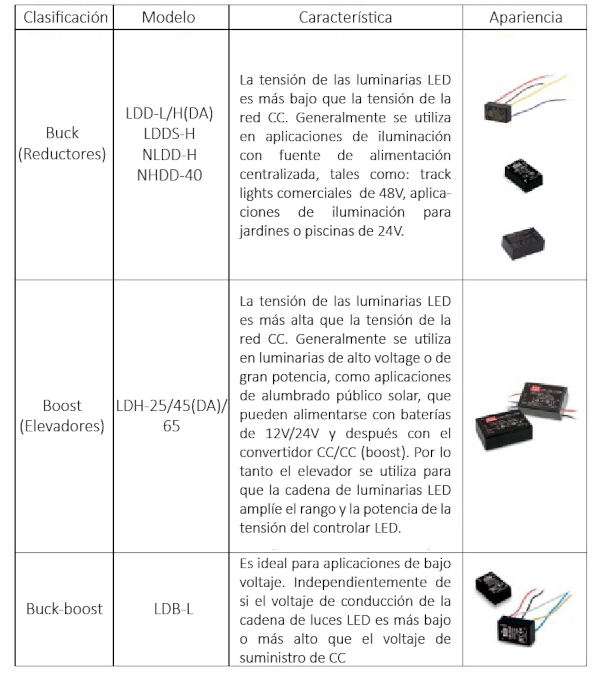
LED drivers (DC-DC) can be classified as buck or step-down (voltage reducers), boost or step-up (voltage boosters), and buck-boost (voltage reducer-boost) according to the structure used. The following table shows the classification and characteristics of the products distributed by Electrónica OLFER and manufactured by MEAN WELL.
Below, we show two application examples.
Buck (Voltage Reducer) Application Example:
As we begin to develop environmental awareness regarding the demand for energy savings and reduced carbon emissions, electric vehicles and green energy are becoming increasingly widespread. The future trend in power supply is expected to be centralized high-voltage DC power distribution. The high-voltage DC power supply bus rail is integrated into the room, as shown in Figure 3. MEAN WELL and OLFER Electronics offer the UHP-1500-HV and RST-7K5-HV series models, with a 380VDC output. In addition to providing fast charging for electric vehicles and powering various devices in the room, the NHDD-40 series (step-down voltage controller) can be used to control lighting fixtures.
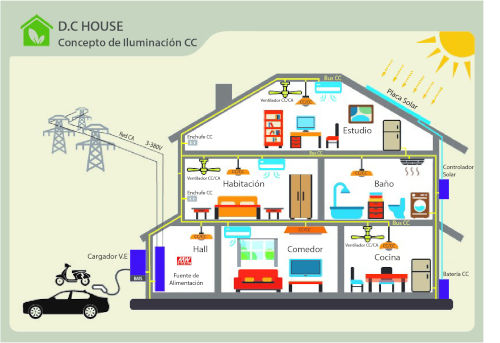 Figure 3. DC House Demonstration
 Example of a Boost Converter Application:
Solar energy, presented as a new, inexhaustible, and environmentally friendly energy source, is one of the antidotes to energy scarcity. Currently, many low- and medium-power streetlights use solar energy as their power source. When the energy demand for solar streetlights is high, a boost converter DC-DC LED driver can be used to increase the number of LEDs in series and decrease the number in parallel. Compared to a buck converter DC-DC LED driver, the current is reduced, and as a result, energy loss is minimized. Overall energy efficiency increases significantly.
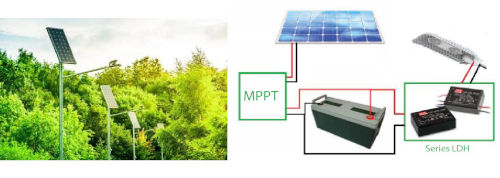 As shown in Figure 4, the solar panel charges the battery via the MPPT controller when there is sufficient sunlight. A low-voltage battery, such as a 12V DC or 24V DC battery, is generally used for safety reasons because it has a more stable charging performance. At night, the LDH-25/45(DA)/65 DC-DC boost converter for LEDs can increase the battery voltage to 12V or 24V to power higher-wattage solar LED streetlights or mobile LED lighting fixtures. Additionally, the boost converter can be used to power car or boat batteries (DC), as shown in Figure 5.
Figure 4. Solar Streetlight Structure
Author: Tony Hsieh / MEAN WELL Technical Department
Translation: OLFER Electronics Marketing Department