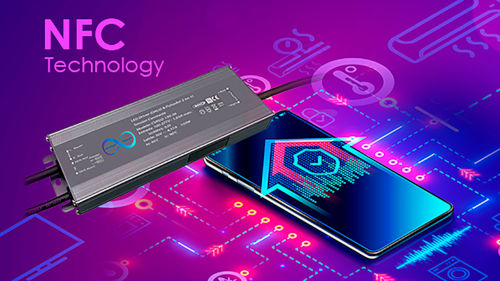
Its creation dates back to 2004, but its rapid adoption has led to its use expanding to an ever-increasing number of devices and diverse applications.
NFC communication is carried out through induction by generating an electromagnetic field which, via the spiral antennas of two nearby devices, allows for the bidirectional exchange of information between them.
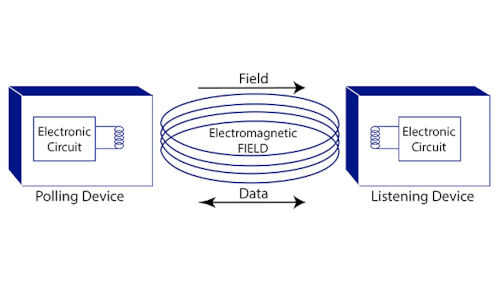 Figure 1. Diagram of the NFC communication operating model.
We can distinguish two different modes depending on which devices generate the electromagnetic field and whether the communication is unidirectional or bidirectional:
• Active NFC: Both devices generate their own electromagnetic field for information exchange. In this mode, the data flow is bidirectional. A practical example would be the exchange of files between two mobile phones.
• Passive NFC: Only one device generates the electromagnetic field, while the other uses this energy to exchange information. In this mode, the data flow is unidirectional. A practical example would be validating a bus ticket using a travel pass.
The data transfer speed of the NFC protocol is relatively slow (up to 424 Kb/s), so other wireless technologies such as Wi-Fi or Bluetooth are used for sharing large amounts of data or at faster speeds. In contrast, the connection speed using NFC is extremely fast (< 0.1s), unlike other wireless technologies such as Bluetooth (> 5s). This characteristic makes NFC technology the ideal method for exchanging information in a multitude of applications.
Some of the most widespread uses and applications of this technology today are the following:
• Mobile payments: NFC technology allows us to carry our bank card on our mobile phone and pay at compatible POS terminals.
• Contactless cards: These allow us to make payments or identify ourselves at an ATM without inserting the card. With other types of cards, we can also, for example, clock in and out for work.
• Action automation (routines): We can automate certain actions using NFC tags. For example, simply reading one of these tags with our mobile phone can connect it to a Wi-Fi network, activate Bluetooth, and put it on silent mode.
• Device synchronization: Some devices can be paired automatically and instantly using NFC technology. For example, you can pair a Bluetooth speaker simply by bringing your phone close to it.
• Device configuration settings: As we will see below, this is one of the applications most closely related to the lighting sector. NFC technology allows us to program auxiliary lighting equipment such as drivers or sensors easily, quickly, and reliably.
Within the lighting sector, manufacturers use a wide variety of programming methods to set the operating conditions of LED drivers in their luminaires. NFC programming is a novel way to perform this process and offers several advantages. For one, it is significantly faster than traditional methods and, compared to adjustments using resistors or switches, much more flexible and comprehensive in terms of functionality. It also requires less training time for the employees responsible for this task on the production line.
NFC technology allows manufacturers to wirelessly set the operating conditions of LED drivers, such as output current, dimming curve type, or DALI address. This process can be carried out on the production line without needing to power the LED drivers from the electrical grid, reducing the effort required to protect workers from working with live voltage and increasing their safety.
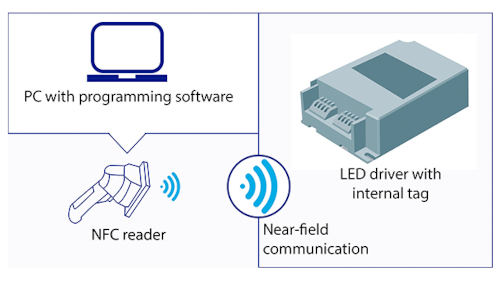 Figure 2. NFC programming of LED drivers – System overview.
The NFC programming system shown in Figure 2 consists of an NFC reader and an NFC tag integrated into the LED driver. The NFC reader is a hardware device that enables the exchange of information with an NFC tag. This tag, in turn, comprises a small antenna and an integrated circuit used to store information that can be read and, sometimes, written by an NFC reader. The NFC tag is a passive device that is activated by the electromagnetic field generated by the NFC reader. Contrary to what the term might suggest, an NFC reader is capable of both reading and writing an NFC tag.
In an NFC programming system, the NFC reader is typically connected to a PC, from which it receives instructions via a specific program installed on it. The NFC reader then wirelessly transfers the programming data to the NFC tag integrated into the LED driver.
The aforementioned combination (PC + software + NFC reader) can also be replaced by a smartphone with an NFC configuration app. Therefore, we can conclude that NFC programming can be performed using dedicated NFC readers as well as a simple smartphone.
There is a wide variety of dedicated NFC readers available. The market offers desktop, pistol-grip, and even portable (completely wireless) models. Furthermore, there are also long-range NFC readers that allow simultaneous programming of multiple drivers without even removing them from their packaging.
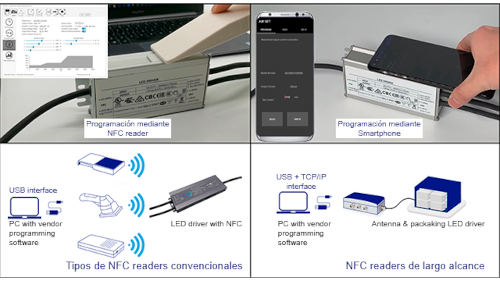 Figure 3. NFC programming methods using a dedicated NFC reader (top left) and a smartphone (top right). Types of conventional (bottom left) and long-range (bottom right) NFC readers.
NFC technology has a number of features that are causing a complete transformation of processes within the lighting sector:
• Speed: It is possible to configure luminaires much faster without having to deal with complex and slow wired systems that require the drivers to be powered by the electrical network.
• Safety: As we have already mentioned, this technology allows luminaires to be configured without being connected to the electrical grid. This means we can program parameters safely at any time, for example, when working on a street light fixture while the disconnect switch is open.
• Flexibility: It allows for reconfiguration of component operating conditions both before and after installation in the luminaire. This enables a customer/integrator to easily modify luminaire parameters (such as power or brightness) if installation conditions change. It also allows a customer or distributor to read the configuration of a faulty unit (even if it cannot power on) and record those parameters identically onto a new device for replacement, using only their mobile phone.
• Cost reduction: This technology allows us to significantly reduce the number of items in our inventory, as well as greatly simplify the analysis of failures in the field or even during after-sales technical service. For example, it would be possible to analyze the operating conditions of a defective piece of equipment returned by a customer to verify whether the working conditions were correct or if any anomaly occurred (overvoltages, short circuits, overheating, etc.) that would void the warranty, even if we were unable to power the equipment due to the failure.
NFC technology, with its ability to simplify and accelerate programming operations, is revolutionizing processes within the lighting industry. At OLFER Electronics, we offer a wide variety of compatible devices and tools with this disruptive technology, which significantly improves field operations by eliminating the need for a power supply, making them safer and simpler. Examples of these products include the CVPD2 series constant voltage power supplies (INFINITUM POWER) and the APD series LED drivers for outdoor applications. These allow configuration in the final stages of the manufacturing process, even directly during installation, and provide exceptional support for diagnostics and fault analysis. Without a doubt, these technologies considerably facilitate manufacturers' operations and are leading lighting toward what appears to be an increasingly connected and wireless future.