

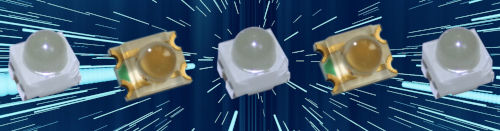
The two new devices join the SMD emitter series launched by OMC in late 2018, which includes a 30-degree beam exit device that has proven very popular.
The two new SMT LEDs provide designers with even more options and flexibility for a wide range of applications, including signaling, indication, detection, and communications.
Narrow beam angle LEDs are often difficult for designers to achieve with the move to surface-mount components. This wasn't a major issue with traditional through-hole (non-surface-mount) LEDs, which are commonly produced with narrow beam angles because the LED body is typically molded around the lead frame using an optical epoxy or silicone. The LED body acts as the lens, focusing the light into beam angles as narrow as 5 degrees. However, with the shift to surface-mount components, some design versatility was lost. With SMT LEDs, the LED body is typically injection-molded from non-optical material that is prefabricated before the LED die is assembled, and therefore doesn't form a lens in the same way. As a result, most SMD packages don't incorporate a lens, emitting light at a wide beam angle that typically exceeds 100°. However, OMC uses a patented post-array encapsulation process and can cost-effectively integrate narrow-angle lenses into a range of surface-mount emitters.
The new 15-degree narrow-angle LEDs and 60-degree SMT LEDs open up design possibilities for engineers who need to provide a clear human-machine interface and ensure precision and accuracy. They are especially suited for high-intensity applications where the beam must be visible from a distance, such as signaling, indication, detection, and communication.