
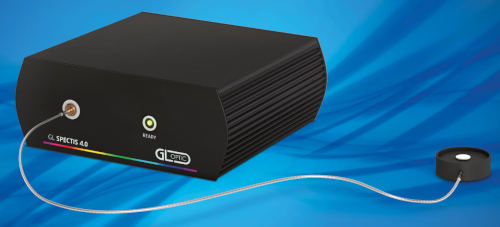
UV radiation is widely used in industrial processes and in medical and dental practices for many purposes, such as treating skin diseases, killing bacteria (disinfection), and phototherapy. It is used to cure inks and resins, inspect artwork, authenticate gems and minerals, verify documents, investigate crime scenes, and control pests. The effectiveness of UV radiation can vary significantly with even slightly different radiation frequencies. This invisible part of optical radiation can only be measured with reliable, calibrated optical measuring instruments. The increasing use of UV LEDs necessitates accessible and reliable measuring tools. This calibrated spectroradiometer can be connected with a small 48 mm integrating sphere for measuring the radiant power of individual sources or a 205 mm integrating sphere for testing larger modules. The award-winning "GL RID One UV" configuration consists of a spectroradiometer combined with a benchtop goniometer system for measuring the angular distribution of radiant intensity.
Radiant power at the exact wavelength value is crucial for designing and evaluating systems involving UV radiation. For example, the sensitivity curve for Escherichia coli, also known as E. coli, is highly wavelength-dependent: the level of contaminants in drinking water will vary for the same radiated power at different points in the UVC range. In pest control, the optimal range for attracting flies is around 365 nm, and this is the wavelength provided by conventional UVA tubes in fly swatters. Changing this wavelength reduces the capture rate. In UVB medical skin treatments, applications that control the narrow beam at 311 nm are critical due to dangerous side effects. A stable, repeatable, and calibrated spectroradiometer is essential for the safe production of UV radiation products.
The high-precision optical measuring instruments manufactured by GL Optic over the past 10 years are now available in various configurations, enabling the measurement of individual LEDs, LED modules, and LED-based UV lamps.
The usable spectral working range of the Spectis 4.0 starts at 200 nm. Depending on the configuration, the FWHM optical resolution can be set to 0.5 nm. Dedicated thermal adjustment allows for stable readings at various application temperatures up to 35°C. Thanks to proper calibration, the absolute UV spectral values are free from stray light interference. Wavelength correction and linearity are verified using an optical bench. The absolute readings are well aligned with the blackbody radiation standard and are checked with a deuterium lamp to detect a short UV radiation range. UV measurements with the GL Spectis 4.0 can fill a gap in many ultraviolet LED applications.