

Normally these operating cycles are pre-programmed in the LED drivers (power supplies) or in external control modules that regulate the drivers, so to modify this programming it is necessary to access the driver or the control module.
It is important to keep in mind that the needs of an installation may change over time, requiring modification of the operating cycle, either occasionally or periodically, or adjusting it to the actual needs.
A simple and economical alternative to make this programming change, without having to climb up to each light fixture to program them one by one or have an expensive point-to-point communication system, are the drivers or regulation units that allow sending a new programming by pulses.
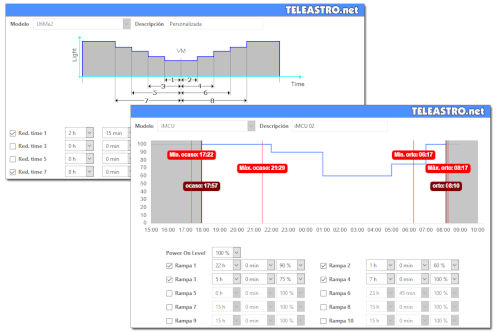
AFEISA has integrated this pulse communication system into its SET90 control units, which, through the existing installation, communicate with the drivers or regulation units, so that, remotely, from the Teleastro.net platform, the different regulation levels and lighting operation times can be modified and configured, without the need to go to the panel or install any additional element to the SET90 control unit.
Currently, the U6Me2 protocol has been incorporated for programming Tridonic LED drivers and the protocol for Vossloh-Schwade iMCU regulation units compatible with most LED drivers on the market.
In conclusion, the integration of this new function allows for greater optimization of the operation and energy consumption of public lighting installations, in an economical and simple way.