
The fact that the desire for greater security is now a reality is demonstrated, among other things, by market data on electronic security technology from the Central Association of the Electrical and Electronic Industries (ZVEI) and the German Federal Association for Security Technology (BHE). After a period of 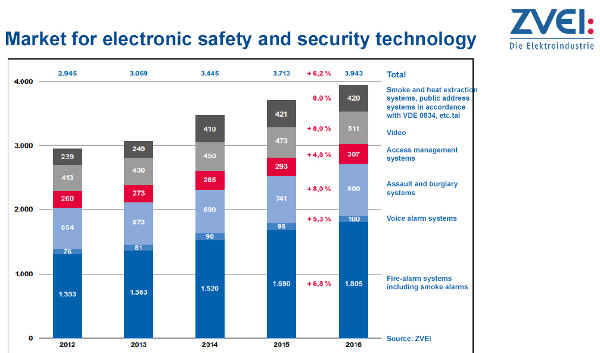 rather moderate growth at the beginning of the decade, manufacturers' revenue in Germany has increased significantly over the past three years, registering growth of 6.2 percent in 2016, with a value of approximately four billion euros (see Fig. 1). The fastest-growing segment has been video technology, with an increase of eight percent. Uwe Bartmann, president of the ZVEI's Professional Security Association, believes that the main reason is, above all, the general increase in the need for security in both the private and public sectors*.
Intelligence through connectivity.
However, increased security and comfort are not achieved solely through the application of security technology. It is through the connection of security devices with each other and with the entire building automation system that a building becomes a smart building and, consequently, adds value for both operators and users. "Electronic security technology is becoming an integral component of the Smart Home and the Smart Building. Security sensors offer entirely new possibilities for data collection," Bartmann explains, describing the overall market growth outlook. Experts expect the sector to receive a further boost with the Internet of Things (IoT). Sensors are becoming increasingly intelligent, smaller, and more affordable, making entirely new applications possible in the future.
The demand is already there.
High added value and new functionalities are the reason why there is already an increase in demand for connected security technology. Door and window sensors, as well as motion sensors from burglar alarm and access control systems, regulate heating and ventilation according to real-time needs. Natural smoke and heat evacuation systems enable sophisticated ventilation concepts during normal operation and are connected to the building automation system via digital bus systems. Remote access to fire alarm systems via the internet facilitates preventative maintenance and efficient service interventions. With the mandatory installation of smoke detectors in Germany, security technology has reached the entire private residential sector. There is currently a clear increase in demand for wireless smoke detectors and for registering their connection to smart home systems. According to a survey conducted by Forsa*, half of Germans use connected smoke detectors.
Security and Data Protection:
Security devices protect people and property and must function correctly at all times. Consequently, the demands on connectivity, especially data transmission over IP networks like the Internet, are also high. Currently, user security concerns still hinder the adoption of smart technologies. For example, an analysis by Accenture* on the Internet of Things shows that more than half of future users have concerns about data protection or attacks by cyber intruders when using smart technologies.
Standards and Regulations:
Reliable transmission, secure authentication, and protection against cyberattacks are only possible with the application of European standards and regulations valid for all providers. This is a fully established aspect in building and industrial automation, but it is still clearly lacking in the field of security technology. However, all stakeholders are moving in the right direction, as many standards with detailed guidelines on connectivity and digitalization have been published. Examples include the DIN EN 50132 series of standards on video surveillance and the new draft of DIN 14676 with numerous guidelines on wireless smoke detectors and their remote inspection.
Light + Building 2018 takes the lead.
Light + Building 2018 brings together all the trends described above regarding smart buildings and becomes the catalyst for the development of modern work and living concepts. For the first time, home and building automation and security technology will come together in Hall 9.1 to form a hub for integrated building technology, offering trade visitors a quick overview of the entire offering.
Building management processes are evolving with digital transformation. Security technology systems are increasingly merging with other building technology systems, systems that, until now, operated completely independently. Interfaces between these sectors play a central role. This theme is the focus of the new special exhibition, "SECURE! Connected Security in Buildings," in Hall 9.1. Complementing the exhibitors' presentations, innovative electrical security solutions will be showcased in three specific application areas (hotel, office, and industrial) under real-world active scenarios (fire, storm, and burglary). The various security and building technology sectors are connected at both the product and system levels. More than 40 companies have already registered for the special exhibition, presenting their products, solutions, and services. Leading security technology manufacturers will also be showcasing their innovative products in other halls of the exhibition center.
Running concurrently with Light + Building, and in the same Hall 9.1, the Intersec Forum, the annual conference on connected security technology, will take place from March 18 to 23, 2018.
All signs point to Light + Building being in a growth phase. A total of approximately 2,600 exhibitors are expected to attend. “As the world’s leading trade fair for lighting and building technology, Light + Building is the ideal platform for the development of smart buildings with future-oriented work and home concepts,” summarizes Maria Hasselmann, Brand Management Director for Light + Building, outlining the goals and aspirations of Light + Building 2018.
*Literature:
1. ZVEI Press Release (07/2017) https://www.zvei.org/presse-medien/pressebereich/zvei-elektronische-sicherheitstechnik-nahe-an-der-vier-milliarden-marke/
2. Forsa Survey “Intelligent Fire Protection Systems”, https://www.cosmosdirekt.de/veroeffentlichungen/rauchmelder-211808/, (2017)
3. Accenture Survey “Igniting Growth in Consumer Technology”, https://www.accenture.com/_acnmedia/PDF-3/Accenture-Igniting-Growth-in-Consumer-Technology.pdf (2016)