While sophisticated, controllable ambient lighting has been almost non-existent until now – apart from backlighting functions – it is now becoming a de facto standard in car interior and exterior design.
The Challenge
: Regarding the design of ambient lighting systems, some manufacturing limitations become apparent. The lighting guide is only located where it can be easily installed by wiring suppliers: from left to right, in the footwell, etc. The lighting guide is difficult to place on the steering wheel, gearshift, and overhead console since these are not connected. To avoid different color tones, completely different colored ambient LEDs are selected (blue ambient light on the lighting guide and orange on the steering wheel buttons). Nothing could be more confusing than four different shades of red on four different buttons.
When there are different suppliers for the lighting guide, steering wheel, overhead console, and door module, the challenge is very complex. Furthermore, the LEDs will come from different suppliers and manufacturing batches, with varying aging curves and temperature drift. This means that the ambient lighting concept cannot be integrated by a company specializing in steering wheel buttons or capacitive touchscreens, but not in wiring installation, binning, compensation, or calibration in LED manufacturing.
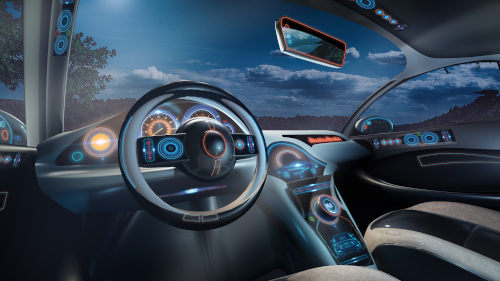 Interior automotive innovation, along with integrated lighting, is very complex. In Figure 1, the lighting is located where the guide rail can be easily installed, near the gauges or at the feet, but not where the lighting makes sense from a design perspective. Furthermore, safety-related features can be incorporated, such as integrations into the steering wheel or the overhead console, as shown in Figure 2.
Figure 2: Concept of ambient lighting in the future in a car.
The different lighting modules don't communicate synchronously, making it virtually impossible to achieve dynamic lighting effects. For example, it's impossible to create a light that moves from left to right. To achieve this, new design methodologies and techniques must be applied, thus opening the door to the next generation of interior vehicle lighting designs. Imagine a Level 3 autonomous vehicle in autonomous driving mode. It will indicate this with a green or blue color. When the car asks the driver to take over steering, it will allow 10 seconds and move dynamically in yellow or red. Shortly before the driver takes control, it will flash red.
The
ISELED solution aims to address this issue by integrating a smart device within the LED module. This module will handle  color temperature compensation, binning, and calibration. As a result, the LEDs will perform identically regardless of the manufacturing batch, over time, and at any temperature. Each LED will display the exact same color temperature, overcoming the challenges car manufacturers have faced until now. Calibration will be performed on each individual LED, and leading manufacturers such as OSRAM and DOMINANT Opto are already producing these LEDs.
Another advantage is the chain's ability to connect more than 4,000 nodes with a very high data transmission speed of 2 Mbps, as illustrated in Figure 3. This specification makes it possible to achieve various types of new dynamic lighting effects, as well as color mixing. Other possibilities within matrix backlight applications, outdoor lighting, and screen backlight control include different stages of dynamic LED backlight dimming to enhance contrast and color quality.
Figure 3: Configuration of an ISELED chain at 2Mbps.
Microchip Solutions:
In practice, a microcontroller is needed to establish communication with the ISELED LED string, requiring a special protocol with an ISELED-compatible serial engine. The advantage of a solution based on a Microchip microcontroller with Core Independent Peripherals (CIPs) is that these unique block sets can be interconnected without intermediate logic or other  peripheral elements, flip-flops, etc. Thanks to this, Microchip can create an ISELED peripheral using only hardware, without the burden of software and CPU processing. These features allow ISELED LEDs to be controlled even with the simplest and smallest 8-bit microcontroller. Microchip also offers ISELED support in all its microcontrollers, up to its high-performance 32-bit AUTOSAR model with 2MB (Figure 4).
Figure 4: Microcontrollers across different applications.
Furthermore, this capability allows them to implement and combine other core design building blocks, further driving innovation. One such building block could be a LIN module, a bootloader, a capacitive touch control module, or a capacitive proximity sensor. With the remaining bandwidth, these solutions can be completed using CIP, minimal software, and the fewest CPU cycles. For example, the PIC18F K42 microcontroller family incorporates an ISELED module and a LIN UART with LIN state machine hardware featuring synchronous interrupt (Sync Break) and autobaud functionality for the UART. This microcontroller family is manufactured with a CAPTouch hardware module.
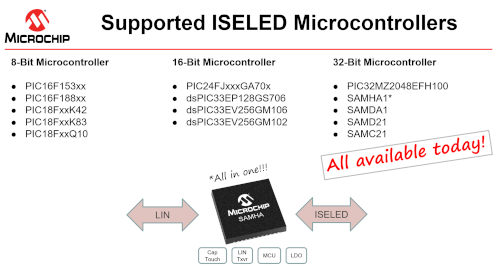 Figure5: Microcontrollers with ISELED and LIN to ISELED solutions on a single chip.
A unique candidate within Microchip's 32-bit catalog is the SAM HA1 family of devices, which integrates Vbat load dump, LDO, and LIN transceiver, as well as ISELED, UART LIN, and PTC modules with capacitive touch sensing. Therefore, a single-chip solution, such as LIN to ISELED, along with an internal proximity sensing module, can be implemented in a 5x5mm package. This is the smallest ISELED solution on the market. Figure 5 shows a list of the microcontrollers currently available for ISELED.
To configure and enable the ISELED peripheral, the module's configuration is integrated into a separate downloadable file called MPLAB Code Configurator. Thanks to this graphical user interface configurator, the peripheral can be configured with a simple mouse click. It can also be combined with other peripherals, such as touch and LIN modules.
Figure 6: MPLAB Code Configurator for ISELED.
The code configurator can be downloaded for free from the Microchip website or through a representative. This requires accepting a free evaluation license agreement, as shown in Figure 6. Microchip also offers development boards for its microcontrollers. These boards incorporate simple connection options for the ISELED hardware, as shown in Figure 7 (other options are also available for the LIN transceiver and capacitive touch sensors). Once the ISELED strings are connected, the code configurator can be used, and development is completed quickly. The goal is to make the innovation provided by ISELED as fast and easy as possible.
 Figure 7: Development board with ISELED connection module.
Conclusion:
RGB interior lighting has presented complex manufacturing challenges. This complexity has limited innovation in many vehicle applications that attempt to combine other functions with ambient lighting. ISELED and Microchip overcome these technical and manufacturing barriers to bring innovation to lighting and other applications, such as sensor integration, proximity detection, and hand detection.
Microchip offers a comprehensive portfolio that enables the use of ISELED with microcontrollers, ranging from high-end 32-bit models to simpler, more affordable, and low-power 8-bit models. Microchip offers combinations of LIN to ISELED, power supply, and capacitive sensing. These are even available in a single-chip device and utilize the smallest LIN to ISELED package, measuring just 5x5mm. The CIPs can be configured using Microchip's free MPLAB Code Configurator and the free evaluation version of ISELED. Finally, the source code can be downloaded onto a flexible development board, offering an innovative and comprehensive high-level solution that shortens the time to market with a low investment cost.