


Thanks to the TENº binary code, the lighting pioneer has managed to bridge the gap between the measurable color coordinates emitted by an LED light source and the human eye's perception of them. The discrepancy between perceived and actual color measurement in different light sources is well-known to scientists, who have studied it for decades. In general lighting, this occurs when there are several white LED light sources in the same space, such as spotlights, wall washers, and projectors.
In 2015, the International Commission on Illumination (CIE 170-2:2015) published a new color space based on several years of research. In addition to the axiom discovered regarding the psychological significance of color space, the most important advancement is a 10° viewing angle for the observer. Osram has applied both of these discoveries to the general lighting market with significant success.
Alexander Wilm, Applications Manager at Osram OptoSemiconductors, explained how color discrepancies arise in white LED units: “Color coordinates in general lighting are measured using the CIE 1931 2° color space. It is also known that the blue, green, and red cells, which are responsible for color perception in our eyes, are equally distributed, and that color perception across the field of vision is constant. In reality, this is not the case, as pigment density varies significantly across the field of vision.”.
Furthermore, he added that, “most of us have had this peculiar experience, which has a significant impact on various markets, without realizing it. In applications designed for museums and retail, for example, color discrepancies are unacceptable, as they fail to display clothing or objects with the best possible lighting. The world's most renowned artists also want their work to look as intended.”.
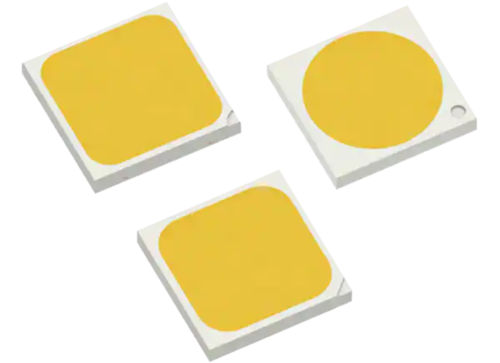
Osram has solved the problem by complementing the CIE 1931 2° xy color space with CIE 2015 10° u'v'. By evaluating color uniformity under real-world conditions not only within a 2° field of view but also with a significant increase to 10°, the binary measurement and encoding provide a much more detailed assessment of color discrepancies. The TEN° binary encoding has been implemented in the new Soleriq S13 LED, achieving unprecedented color discrepancy in LED lighting.