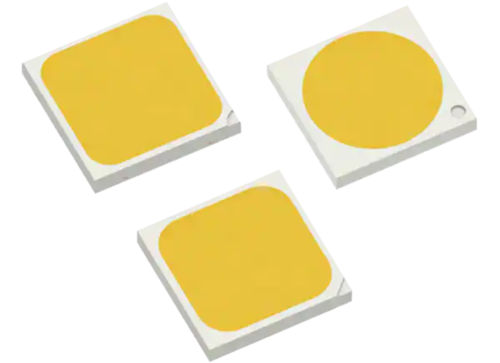


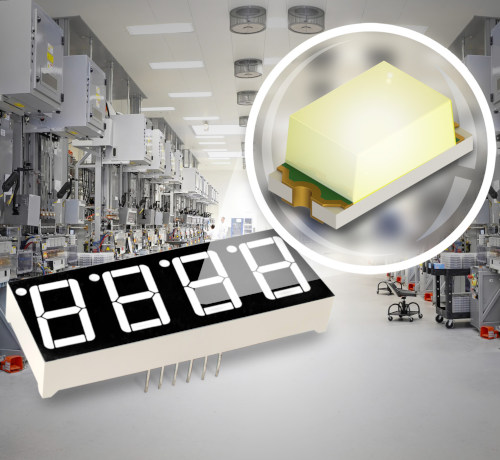
In recent years, the need to improve both the design quality and visibility of industrial equipment has increased the use of white LEDs for digital displays and visual indicators in these applications. High-reliability LEDs are required to ensure that brightness does not degrade, even with continuous operation for more than 10 years. However, this has not been possible until now due to the use of epoxy or silicone resins for molding typical white LED chips. These types of materials could not provide sufficient reliability to prevent brightness degradation or offer enough encapsulation strength to facilitate mounting on printed circuit boards.
ROHM has been supplying 1608-size LED chips in colors ranging from red to green, and is now adding white to this product range to meet market demand. The adoption of a new material that combines the benefits of epoxy and silicone resins has made it possible to achieve class-leading reliability for the white LED chip in such a small package.
ROHM's tests have shown that the SMLD12WBN1W maintains 100% of its brightness after 1000 hours of operation (@25°C, IF=20mA). This represents a 20-fold improvement in lifespan compared to other similar products on the market. Further testing has demonstrated that the assembly's durability is 25-fold improved with the new material compared to products using silicone resin. This will contribute to reducing manufacturing failures when mounted on printed circuit boards.
 ROHM is committed to continuing to develop highly reliable LEDs and to strengthening its product range with a focus on increasing usability. (fig. 1)
Key features
1. 100% of the luminous intensity was successfully maintained during operational tests (25°C, IF=20mA, 1000 h). Traditionally, red and green LEDs used in the display panels of industrial equipment are less prone to causing resin yellowing due to light energy. Therefore, brightness degradation has not been considered a problem. Epoxy resins with high molding hardness are typically used for compact-molded LEDs. However, in the case of LEDs with a short wavelength (λD<527nm), such as white LEDs, the resin can yellow due to light energy. To address this issue, the SMLD12WBN1W uses a new sealing resin material that maintained 100% brightness during operational tests (25°C, IF=20mA, 1000 h). This translates to an approximate lifespan. 20 times greater compared to the residual luminosity shown under the same conditions by similar products available on the market.
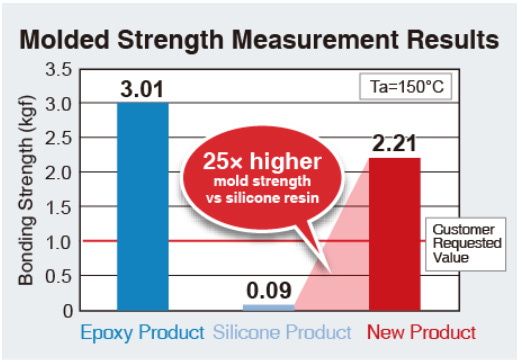
2. 25-fold greater encapsulation strength than those using silicone resin. Although light intensity degradation can be improved using silicone resin, the molded part is easier to separate from the substrate. Measures to improve mounting strength, such as incorporating reflectors into compact LEDs, cannot be used, and damage to the molded section remains a challenge. (Fig. 2) The use of a new resin material improves mold strength by 25 times compared to products using silicone resin, even at high temperatures (Ta=150°C). This minimizes defects during assembly on circuit boards, thus achieving superior mountability.
Gamma (fig. 3)