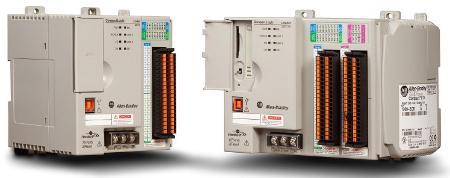
 These control installations may also need to communicate with higher-level systems, and with this in mind, the L2 offers impressive connectivity capabilities. With two Ethernet ports and an integrated Ethernet switch, the controllers support Device Level Ring (DLR) network topologies, which simplify the integration of components into a control system while reducing system costs. The dual ports also provide resilience to network connection loss; enable one-at-a-time device replacement without interrupting production; and reduce the number of Ethernet switches in the control system.
The L2 controllers also provide a powerful, scalable, and competitive motion solution. When combined with the Allen-Bradley Kinetix 350, they can support up to four axes of integrated CIP motion.
As part of the Integrated Architecture system, the CompactLogix 5370 L2 controllers use the same programming software, network protocols, and reporting capabilities as all Logix controllers, providing a common development environment for all control disciplines.
Available in three models (L24ER-QB1B, L24ER-QBFC1B, and L27ERM-QBFC1B), these devices can reuse existing 1769 I/O and their enhanced analog resolution capabilities to support thermocouple and RTD inputs. They also support Kinematics, eliminating the need for additional robot controllers and software. All variants offer 16 digital inputs and outputs, and the L24ER-QBFC1B and L27ERM-QBFC1B offer up to four universal analog inputs, two analog outputs, and four HSC channels.
Additional features and benefits include built-in energy storage, eliminating the need for lithium batteries; a removable 1 GB Secure Digital (SD) card for improved data integrity; and open socket capability, enabling support for Modbus TCP and devices such as printers, barcode scanners, and servers.
The new CompactLogix 5370 PAC range offers users the ability to deliver the performance they need to meet the demands of their systems. Fully scalable—both up and down—users can migrate programs to the L1 variant for simpler installations, or up to L3 for more complex applications. With a single common network and development environment, engineering effort is reduced, and significant time and money can be saved on migration tasks.
Corrosion protection for swimming pool control panels
Neither the garden pool nor the indoor water park or spa would function without the essential pumps, heaters, chlorinators, and lights that service the facilities. These pool automation systems are typically housed in electrical control panels near the pools...