When you specify an AC/DC power supply for your project, you face a task that is both simple and complex. Naturally, you need to select one with the appropriate output voltage and current ratings, as well as the correct input voltage range. That is indeed the easiest part.
But other issues must be addressed. What distributed power topology will you be using? What are the thermal and mounting/location options for the power supply?
We're not going to discuss the internal topologies of AC/DC converters. There are well-known design methods, but for the user, the source must be considered a "black box" with its input, output, and performance characteristics.
Distribution Topology:
If all you need is a single-rail DC power supply to feed a single printed circuit board from the AC source, the situation is relatively straightforward. For example, you might need to supply 12VDC at 20A (240W nominal) to a medium-sized board, and any additional power requirements are handled locally on the board. Consider yourself lucky and move on to the thermal aspects.
However, many applications require that single voltage on two or more boards, or different voltages (and currents, naturally). At this point, you can choose between one large power supply or several smaller ones, as shown in Figure 1.
Many applications utilize the multi-stage distributed power supply technique, in which the AC/DC source feeds one or more intermediate bus converters (IBCs), which in turn transform the DC voltage from the AC/DC source into lower-voltage DC rails. For example, each IBC might take 48 VDC and supply 12 VDC, 5 VDC, 3 VDC, and other voltages required by the circuitry, as shown in Figure 2.
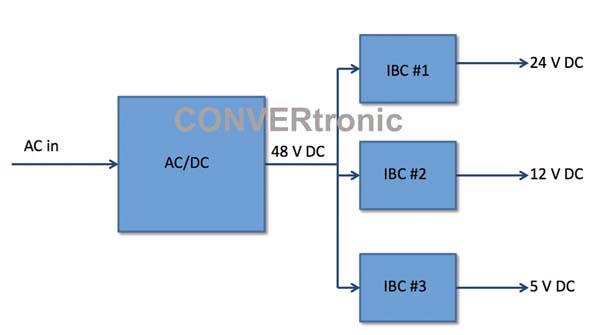 If the system uses IBC, the decision regarding the type of AC/DC converter required is simplified once again. In most designs, there is a single intermediate bus voltage, such as 48 VDC or 12 VDC (some more complex systems use multiple IBC power rails). Therefore, you can focus your efforts on finding one or more AC/DC sources to supply the desired intermediate voltage(s) with sufficient current.
Efficiency is all the rage, and for good reason.
Efficiency is "booming," and not just because it sounds politically correct or virtuous. Efficiency and heat dissipation in the load have a major impact on design and placement, as well as on operating and life-cycle costs.
Several regulatory standards require minimum source efficiency values, the specific value of which depends on the source's rated power. The good news is that almost all sources from accredited suppliers meet these standards. However, it is essential to ensure that the source is certified for the countries where its product will be used, as standards are not fully harmonized.
Since almost all AC/DC power supplies have an efficiency of around 85 to 95%, why should you pay attention to the exact figure? After all, the switched-mode power supplies available today represent a vast improvement over the 50-60% efficiency of older linear (non-switched) power supplies.
Here's why: even a few percentage points can make a big difference in three ways. Let's take the example of a casino with hundreds of slot machines:
• First, the additional energy must be supplied, which adds to the overall cost.
• Second, the heat generated by the power supplies must be dissipated; this again increases the cost.
• Finally, heat is the killer of electronics, and even a few degrees of temperature can significantly shorten the operating life of a power supply, resulting in its replacement, labor costs, and a product that is not generating revenue for several hours or much longer.
Note that a properly designed and built power supply, operating within specifications, has a mean time to failure (MTTF) of several hundred thousand hours. However, a 10°C increase can reduce the MTTF by half.
So what should you do? Choose the most efficient power supply that fits your bill of materials budget, and also consider operating and lifecycle costs. But pay attention to efficiency levels, as they are not constant across the entire load range. Most suppliers provide an efficiency-to-load graph that shows the power supply's performance from a small load—around 10%—to its maximum load. Power supplies typically have a peak efficiency point of around 85–95% of their maximum rated current, as shown in Figure 3.
 Determine where your product falls on the load curve, as well as its duty cycle, to decide on the necessary efficiency and the cost benefits of higher efficiency. A power supply that primarily operates at medium loads (50%) with 85% efficiency, and only occasionally near maximum load (90%) but with a much higher efficiency of 95%, would have a very different cost than one that is slightly less efficient (such as 93%) at 90% load, but operates at this level most of the time. The initial cost may not be worthwhile, or it may even be pointless, depending on your product's operating modes.
Similarly, don't oversize the power supply in order to achieve greater efficiency and a longer lifespan. For example, if you need a power supply that can deliver 400 W, you'll look for one rated at around 500 W. You could also get a 1000 W power supply, which would certainly have more capacity than you need. However, it would be less efficient than the 500 W power supply, you would have to pay more for the power supply, and your operating costs would be higher.
Where to place the power supply?
The location and orientation of the power supply are important factors for success. Some power supplies are designed and specified solely for convection cooling without forced airflow; others use active airflow cooling (usually from a fan, but cooling units are also used in some cases). Other passive cooling techniques include heat sinks, heat pipes, and cold plates; all of these increase the cost and complexity of the design.
In general, forced-air cooling allows for a less expensive power supply design, but the cost and reliability of the fan must also be considered. The power supply supplier will specify the airflow in cubic feet per minute (CFM) and the temperature at which the power supply should operate.
Whether you use passive or active cooling, you must also consider the power supply's location and orientation. Most power supplies have a specific orientation, and changing this will result in inadequate airflow to the heat-generating components and adjacent components. If you have questions about mounting and its impact on the power supply's performance, you should work closely with the supplier for more detailed information.
The truth is that power supplies are often placed in a location with ample space, surrounded by numerous devices and frequently near other heat-generating components, such as printed circuit boards containing processors or motors. The ambient temperature can be much higher than anticipated, and that's what matters. Therefore, it's crucial to understand where heat is dissipated in the system beyond the power supply itself, and how it gets there. This may need to be considered in your cooling strategy or when evaluating the power supply's specifications.
Now, let's move on to the electrical specifications.
 Once you've analyzed the other aspects, you can focus on the electrical specifications. Start, naturally, with the AC portion of the AC/DC converter, and immediately ask about the AC line rating and voltage.
Will your AC line be only 120 VAC, only 220 VAC, or do you need to handle both line voltages with a single power supply? Generally, the power supply is less expensive when it operates on a single AC voltage range, but the difference is quite small for most power supplies. Some suppliers don't even offer units for a single line range because designing, certifying, and delivering two similar power supplies presents a significant logistical challenge.
The main question is the required line tolerance. The greater the tolerance around the nominal value—5%, 10%, or more—the more difficulties the power supply will face, especially when it is required to deliver the maximum output value with the minimum line voltage; note that a power supply can be specified across the entire range of 90 to 264 VAC. Furthermore, the resulting line voltage fluctuations make it difficult for the power supply to maintain its regulated output, even if the load remains constant.
As with most engineering designs, these “extreme” operating cases are the ones that require a careful study of the supplier's data sheets and observing whether the maximum/minimum specifications are maintained under the most unfavorable conditions or only at the nominal points.
Regarding the DC portion, look up the required voltage(s) and corresponding current rating(s). There's not much to say about this; either the power supply is specified as being able to provide what's needed, or it isn't. Check if the power supply's output regulation meets your requirements; this refers to its ability to maintain the rated output within a certain tolerance, despite variations in the current supplied by the power supply.
Most suppliers offer screw terminals for the DC output, but connectors are also available as standard. Screw terminals reduce the cost of interconnecting cables, but they require more work during final product assembly and are susceptible to potential wiring errors.
Other features that need to be checked are related to regulatory compliance. The most important of these concern efficiency; power factor correction (PFC) (how much the line current varies with the voltage); safety issues such as insulation and fault modes; the RoHS directive (reduction of hazardous substances); and electromagnetic interference (EMI). Verify that the supplier meets the applicable standards and certifications, as almost all do (see Figure 4 for a table listing the compliance requirements of a representative source, the N2Power XL375 series).
 If that's not the case, go to another supplier, as there's little you can or shouldn't do if the power supply doesn't meet any of these requirements. Even if you could do something, there's no way to certify the repair, so the engineering effort would be wasted.
Almost all power supplies, such as the N2Power XL375 series (Figure 5), incorporate standard protection features like overvoltage protection (OVP), output current limiting, and shutdown (total short circuit), as well as thermal shutdown. This power supply offers shutdown upon instruction, loss of input power, or whenever excessive loads or temperatures are detected, and provides the host system with a warning of an impending shutdown, allowing it to perform internal management preparatory operations before power is lost.
Finally, check the power supply's ability to handle line transients. All power supplies can handle this to some extent; there is, of course, an IEC transient test waveform. But your application may be exposed to much larger transients due to nearby nuisance loads (relays, motors), lighting, and other factors. You may want to add extra transient protection by using a low-cost passive component at your AC mains connection, before the power supply input.
In conclusion
, current AC/DC power supplies are notable for being efficient, compact, versatile, and robust, and they also incorporate complex control strategies, algorithms, and protection mechanisms. At the same time, they meet a wide variety of performance and safety standards. First, decide which power supplies you need and at what point—functionally and physically—you are ready to take the next step, which involves finding a supplier of the specific models that meet your needs and cost objectives.
Author:
Don Knowles, Vice President of Engineering, N2Power