

However, a common problem arises when managing the excess energy generated during road tests, battery charge and discharge cycles, or the discharge of energy storage systems before shipment. Traditionally, this excess energy is dissipated as heat using resistive load banks or electronic loads.
Although seemingly simple, this approach presents challenges in terms of thermal and noise management, making it less straightforward than it appears.
This raises the question: can this excess energy be recycled and used within the facility? In recent years, there has been increasing pressure for industrial facilities to be more environmentally friendly and operate more energy-efficiently. Regenerative electronic loads represent one energy-saving solution, as they redirect load power back into the electrical grid, offering a greener alternative to resistive load banks.
The potential energy savings can be substantial, especially for large industrial facilities with extensive testing operations. For example, EA Elektro-Automatik's regenerative electronic loads boast an impressive 96% efficiency, enabling companies to recycle most of the energy that would otherwise be wasted. This marks the evolution of programmable DC power supplies, where all energy is fed back into the local grid. In this blog, we'll explore the amount of energy savings an industrial facility can achieve by switching to a regenerative load.
Excess Energy Dissipation: Resistive and Electronic Load Banks.
DC load banks are used to simulate electrical loads in order to test power supplies and ensure they meet the manufacturer's specifications or ratings. These loads accurately mimic the behavior of a real load during testing without being connected to the load's normal operating system. Excess energy is typically dissipated as heat. Load banks can be resistive, reactive (inductive or capacitive), or capacitive.
The most common type, the resistive load bank, simulates the load by converting electrical energy into heat using power resistors. During testing, the load bank is connected to the output of a power source (generator, battery, amplifier, photovoltaic system) instead of its usual load. The load bank exhibits electrical characteristics similar to those of the standard operating load while dissipating the output power that the load would normally consume.
The power is converted into heat by a high-power resistor or a bank of resistive heating elements. This method replicates, verifies, and tests real-world demands in critical power systems. Load banks are also used with intermittent renewable energy sources, such as wind turbines, to discharge excess energy that the grid cannot absorb.
Resistive load banks offer a cost-effective solution when noise, workspace, and efficiency are not critical considerations for the application.
Wasteful Applications: Energy Storage Device Discharge and Burn-In Testing.
Regardless of load programmability, the load must dissipate excess energy as heat. This task is not always straightforward and often requires convective cooling using forced air (fans) or liquid immersion (water tank). The most common dissipative load is the resistive load bank, in which power resistors burn energy as heat, wasting 100% of the energy. These resistive load banks can be noisy and add significant ambient noise to the factory environment. In addition, active cooling systems increase the energy load, as they require additional power for air conditioning, fans, or cooling tanks.
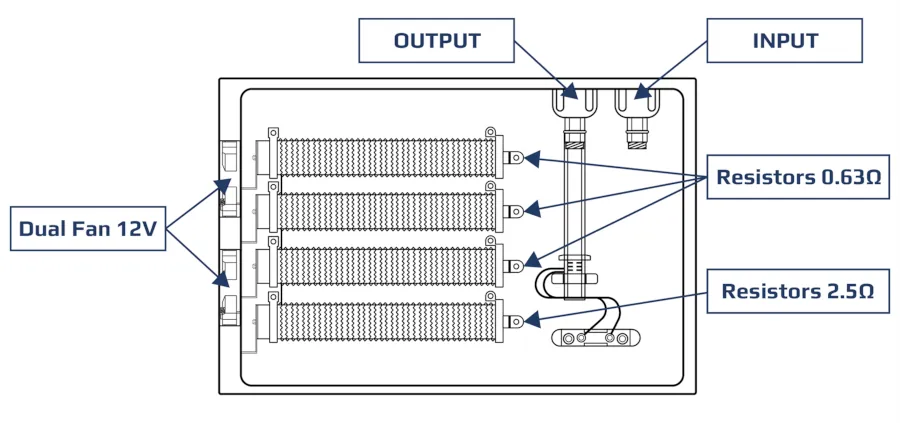
Image of a resistive load bank with DC fans, which adds significant noise to the factory environment.
Certain tests require a significant amount of power dissipation. For example, industrial testing of batteries and fuel cells requires discharging the cells before shipment to ensure safe integration into a stack or larger system.
Burn-in testing (DUT) for various devices under test (DUTs), such as DC power supplies, motors, inverters, microinverters, batteries, and fuel cells, also requires fan-cooled resistive load banks. These burn-in cycles are run continuously for several days and ensure the DUT's longevity under normal, accelerated, or extreme environmental conditions before performance testing.
Operating these laboratories is expensive, and many facilities run tests around the clock. For example, battery validation often involves testing numerous devices in parallel. Utilizing every last amp-hour the battery offers throughout its lifespan is crucial, and the test setup includes device unit testing (DUT), environmental chambers, automated test equipment (ATE), and test/analysis software.
Adopting Greener Solutions: Regenerative Electronic Loads.
In testing technologies such as batteries, traction controllers, bidirectional electric vehicle chargers, and fuel cells, both a source and a sink are needed. For example, testing a battery requires charging and discharging to examine the bidirectional energy transfer during regenerative braking. Traditionally, these tests are performed using a programmable DC source and either an electronic load or a passive load (resistor bank). In contrast, regenerative electronic loads can convert the discharge power (P = V * I) into usable electricity for the installation.
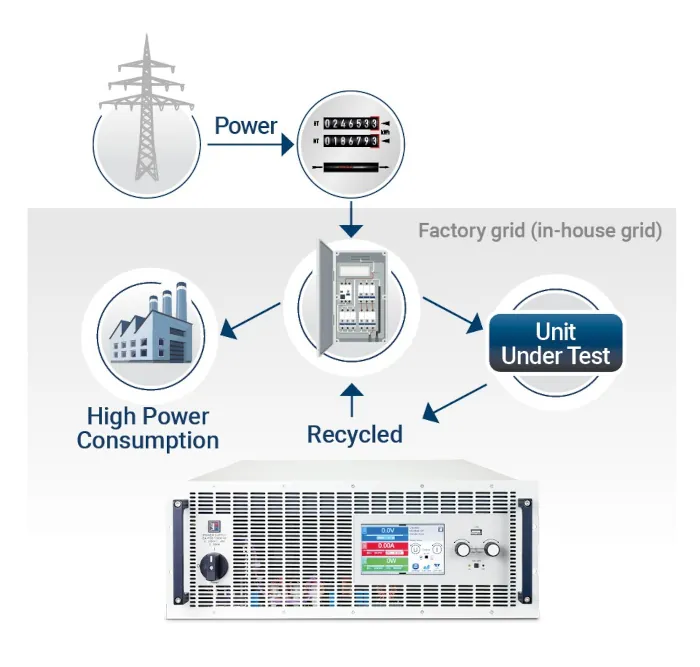
Energy flow with the regenerative power supply
This approach offers economic advantages in two ways:
by reducing overall power demand and associated electricity costs, and
by keeping devices cooler, thus reducing energy consumption for facility cooling.
This allows for greater flexibility when planning, upgrading, or reorganizing laboratory or manufacturing workspaces.
The advantages of EA's bidirectional power supplies:
EA's bidirectional power supplies (PUB series) integrate regenerative electronic loads and programmable power supplies into a single device. Instead of wasting energy, a regenerative load returns excess energy to the local grid. The energy passes through a DC-DC converter to a DC-AC inverter (current source), which synchronizes with the distribution network to recycle the energy.
In addition to the regenerative load function, these power supplies also incorporate true auto-range selection capability, allowing them to emulate a wide range of voltages and currents from a single solution. Furthermore, they feature an integrated arbitrary waveform function generator, simplifying test setups and enabling a wide range of dynamic test applications.
The power supplies can easily switch between common digital industrial interfaces such as RS232, Profibus, CAN/CANOpen, DeviceNet, Modbus, Ethernet, Profinet, and EtherCAT via Anybus communication.
Return on Investment (ROI) for Regeneration:
Implementing regenerative electronic loads offers a significant return on investment (ROI). For example, a facility consuming 20 kW of power with extensive testing operations can achieve substantial savings. Using the average US electricity rate of $0.30 per kilowatt-hour (kWh) for a 40-hour workweek,
the savings associated with this scenario are:
$124,416 total annual savings in energy consumption;
over 98% reduction in energy consumption
; ROI of the regenerative electronic load (ELR) purchase in 24 months;
ROI of the ELR replacing the traditional resistive load in 13 months.
Author: Author: Craig Frahm, Tektronix
Source: https://www.tek.com/en/blog/reaping-energy-savings-the-power-of-regenerative-loads