




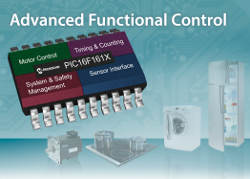
 These new microcontrollers introduce and expand Microchip's Core Independent Peripherals (CIP) offering, designed to reduce interrupt latency, decrease power consumption, and increase system efficiency and security, while minimizing design time and effort. These peripherals also reduce system complexity by eliminating the need for external code and components. Hardware-based peripherals offload critical, core-intensive timing functions from the CPU, allowing it to focus on other critical tasks within the system.
The PIC16(L)F161X microcontrollers offer a Math Accelerator (Math ACC) with PID (Proportional-Integral-Derivative) capabilities, which performs calculations completely independently of the core and can carry out 16-bit mathematical and PID operations. The family also incorporates the AngTmr (Angle Timer), a hardware module that calculates the rotation angle for functions such as motor control, TRIAC control, or capacitive discharge triggering systems. Regardless of the speed, the AngTmr allows for successive interrupts for a specific rotation angle or sinusoidal output without requiring core processing. The PICs can be configured to perform a set of specific functions that increase execution speeds and decrease software requirements. Offloading these functions frees up the CPU for other tasks, reduces program memory consumption, and lowers the microcontroller's overall power consumption.
In addition to Math Acc and AngTmr, the PIC16(L)F161X features other peripherals designed to simplify implementation and add flexibility to various functions. The 24-bit Signal Measurement Timer (SMT) obtains high-resolution measurements of the digital signal in hardware, resulting in more precise and accurate measurements. It is ideal for speed control, range calculations, and RPM indicators. The family also includes a Zero Cross Detect (ZCD) module that can monitor AC line voltage and indicate zero-crossing activity, thus simplifying TRIAC control applications by greatly reducing both CPU load and bill of materials cost. Along with the new 100mA high-current I/O, the proven Configurable Logic Cell (CLC), as well as I2C™, SPI and EUSART for communications, this high level of integration helps streamline design, as well as facilitate implementation and increase flexibility.
The family also contributes to the implementation of safety standards such as Class B and UL 1998, as well as fail-safe operations, thanks to the combination of a Windowed Watchdog Timer (WWDT) that monitors the correct operation of the software within predefined limits to improve reliability, and a Cyclic Redundancy Check with Memory Scan (CRC/SCAN) that detects and scans memory for corrupted data. In addition, Hardware Limit Timers (HLT) detect hardware failure states such as jams, stops, etc., allowing engineers to integrate safety and monitoring functions into their applications with minimal or no CPU load. Along with these features, the family offers low-power XLP technology and is available in small 8-, 14-, and 20-pin packages.
The PIC16(L)F161X family is supported by Microchip's standard suite of premium development tools, including PICkit™ 3 (part number PG164130, $47.95) and MPLAB®
ICD 3 (part number DV164035, $199.95). The MPLAB® Code Configurator is a plug-in module for Microchip's free MPLAB® X IDE, providing a graphical method for configuring 8-bit systems and peripheral functions, enabling users to move from concept to prototype in minutes by automatically generating efficient and easily modifiable C code for each application.
The PIC12(L)F1612 microcontrollers are now available for sampling and volume production and are supplied in 8-pin PDIP and SOIC packages, and 3 mm x 3 mm DFN and UDFN packages. The PIC16(L)F1613 microcontrollers are also available in 14-pin PDIP, SOIC, and TSSOP packages, and 4 mm x 4 mm UQFN and QFN packages. The PIC(L)F1614 and PIC(L)F1615 are now available for sampling in 14-pin PDIP, SOIC, and TSSOP packages, and 4 mm x 4 mm UQFN and QFN packages; volume production is planned for January. The PIC16(L)F1618 and PIC(L)F1619 microcontrollers are also available for sampling in
20-pin PDIP, SOIC, and TSSOP packages, and 4 mm x 4 mm UQFN and QFN packages; volume production is planned for January.





