
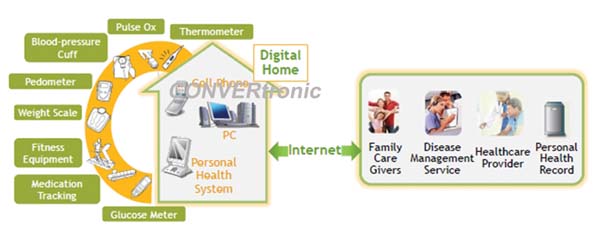
 Globally, the number of people aged 60 and over was 600 million in 2000. By 2020, this figure was expected to have doubled and could triple by 2050. More than 600 million people worldwide suffer from chronic diseases, and according to the American Diabetes Association, in the U.S. alone, nearly 21 million people—approximately 7% of the population—have diabetes. Healthcare spending on these diseases has increased sharply, and experts predict it will rise from $500 billion annually to nearly $700 billion by 2020.
Therefore, society needs to embrace technological advancements to reduce costs and improve quality of life, both in the daily management of chronic diseases like diabetes and in enabling older adults to live independently for as long as possible.
The technological advancement with the greatest potential impact on chronic diseases and elder care comes in the form of connectivity. The ability to instantly communicate personal medical data from a home diagnostic device to a healthcare professional will save costs and provide a more detailed analysis of a patient's condition. Sometimes referred to as eHealth or telemedicine, the use of modern connectivity, both wired and wireless, represents a significant step forward in the fight to improve healthcare and reduce its cost. However, creating an eHealth ecosystem will require interoperability based on a set of industry guidelines and must be adopted globally.
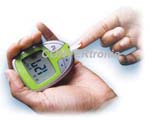
To this end, Renesas Electronics has become a member of the Continua Health Alliance, which is developing a comprehensive set of guidelines for the emerging eHealth ecosystem. Renesas Electronics has also developed a certified demonstration platform for blood glucose monitoring that utilizes the low-power 32-bit V850ES/JG3-L microcontroller and the necessary Continua profiles for seamless interoperability.
The Continua Health Alliance is an open, non-profit industry organization comprised of medical and technology companies collaborating to improve the quality of personalized healthcare. With over 240 member companies worldwide, Continua is dedicated to establishing a system of interoperable, connected, personal healthcare solutions, recognizing that bringing such solutions into the home fosters independence, empowers individuals, and offers the opportunity for truly personalized health and wellness management.
Although the addition of connectivity will make diagnostic devices suitable for eHealth, the key to a successful design remains the choice of microcontrollers, with added RF transceivers that can be integrated into the microcontroller or can be standalone external devices.
For the design of a blood glucose monitoring device, it is important that the microcontroller meets these key requirements:
- A/D conversion for sensor inputs
- D/A conversion for audio output
- User interface support for LCD display
- Support for USB 2.0 peripherals
- DMA support for data transfer between peripherals and memory
- Hardware counters and timers (such as supervisor timer, real-time clock, and timers) for controlling analog signal capture and generation
- Small package sizes such as WQFN and FBGA
- High-quality, secure Flash memory with error-correction encoding
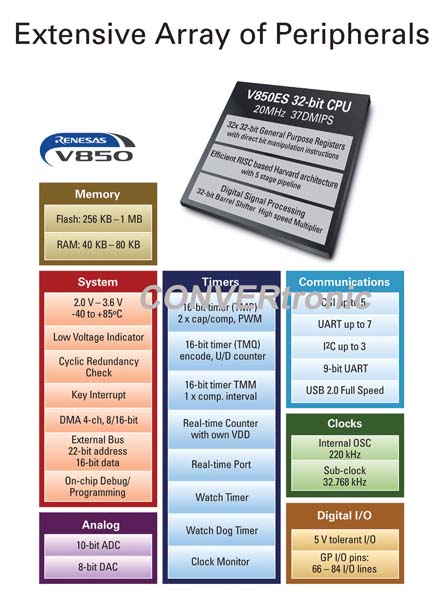
The V850ES/JG3-L with USB device is a 32-bit microcontroller capable of delivering 38 DMIPS (version 2.1) at a 20MHz operating frequency and comes with 256kB to 1MB of Flash memory. It offers low-power operation in a small footprint (8x8mm FBGA) with the processing power required by a medical diagnostic device such as this for blood glucose monitoring.
The peripheral package is extensive and includes system management hardware, analog electronics, timers, and communications equipment. System management functions include a bus control function that manages the general-purpose I/O ports, a four-channel Direct Memory Access Controller (DMAC) to handle both internal and external transfer requests, and a standby mode controller that manages the seven low-power operating modes. Analog functions include twelve channels of 10-bit analog-to-digital converters with a minimum conversion time of 5 µs, and a two-channel digital-to-analog converter with 8-bit resolution and a minimum conversion time of 3 µs. As for timer functions, it has three general-purpose 16-bit timers/counters, each with multiple channels, a supervisor timer that can reset the system or generate an interrupt in case of overload, a clock generator that creates the various clock signals used by the CPU and peripherals, and a real-time clock (RTC) to know the time and date.
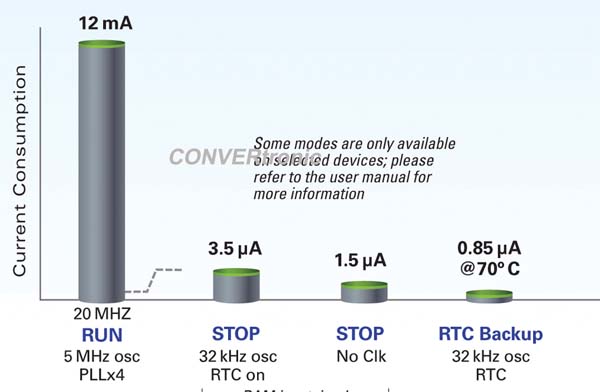
A critical aspect of blood glucose monitoring device design is minimizing power consumption to extend battery life and ensure measurement accuracy. If the battery life is too short, the user may miss a scheduled measurement because they have to recharge or replace the battery. The V850ES/JG3-L incorporates low-power process technology and an optimized power architecture, resulting in exceptionally low current consumption without sacrificing performance. The V850ES/JG3-L
features several low-power operating modes that can further reduce energy consumption and extend battery life. These modes include:

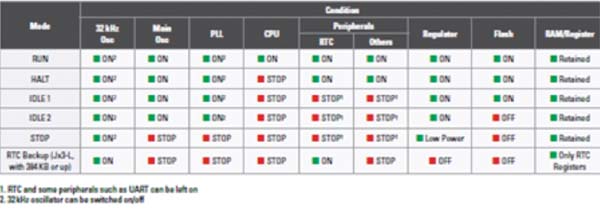
- HALT: Only the CPU clock is stopped; peripherals remain active.
- IDLE1: All internal circuits are stopped except for the oscillator, PLL, and Flash memory.
- IDLE2: All internal circuits are stopped except for the oscillator.
- STOP: All internal circuits are stopped except for the secondary clock oscillator.
- RTC backup: The real-time clock (RTC) continues to use the 32kHz clock, utilizing the current supplied by the backup voltage to the RVDD. Power consumption in this mode is even lower than in STOP mode.
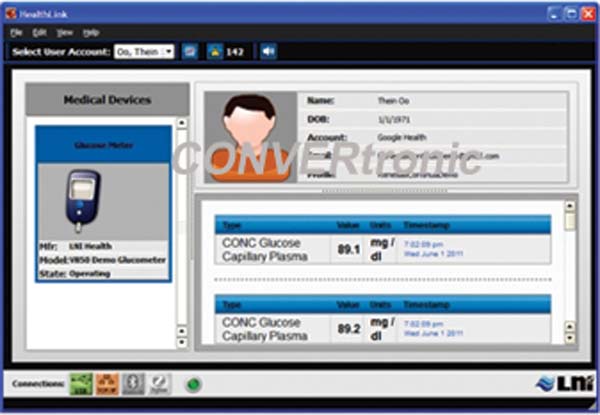
To aid in evaluating both the V850 microcontroller and the Continua profile, Renesas Electronics has developed a demonstration platform for the Continua-certified blood glucose monitoring device. The DM-V850ES-JG3LUSB-CD includes a V850ES/JG3-L USB microcontroller, a two-line chip-on-glass (COG) LCD display, four keys, an adjustment port, and a connection for simulating a blood glucose test strip. This board demonstrates USB connectivity with the PHDC (Personal Healthcare Device) driver by implementing the Continua standard for a blood glucose monitoring device. This implementation includes the IEEE 11073-10417 standard for glucose monitoring and the IEEE 11073-20601 standard for communication between a Continua agent and a Continua manager. The Continua-certified demonstration utilizes USB data transfer. The demonstration card simulates blood glucose measurement using a variable resistor and allows the user to:
- Simulate readings and store data in non-volatile storage. Read a simulated input by pressing a button. Use EEPROM emulation to store data. - Compatibility with any data that the Continuous Glucose Manager may request. The LCD display indicates that communication is active until it is completed. The transfer is activated by pressing a button. - Display the current measurement for different modes and frequencies. Pressing a button allows you to cycle through different modes and display the current measurement. - Transparent operation between USB and battery power. By connecting a USB cable, the system can be powered via USB. - Support for real-time clock (RTC) and time logging. Uses an RTC to record blood glucose measurement data over time and perform real-time monitoring. - Support for development/debugging as an evaluation platform. Connecting the platform to the Renesas Minicube debugging and programming tools allows for the evaluation and development of the entire system.

In summary, Renesas Electronics is the world's leading supplier of 32-bit microcontrollers and an active member of the Continua Health Alliance, as well as one of the first to offer a fully Continua-certified blood glucose monitoring demonstration platform. Looking ahead, Renesas aims to provide certified healthcare platform solutions utilizing its cutting-edge microcontrollers with low-power wireless networking standards such as Bluetooth, ZigBee, and Wi-Fi, as well as wired USB and Ethernet standards.
Author:
Article provided by Renesas