




 Extending battery life
One of the main techniques for extending battery life is to keep the microcontroller in its lowest power consumption mode for as long as possible. Figure 1 illustrates how high operating speeds and short wake-up times can be combined to reduce average power consumption. The goal, therefore, is for the microcontroller to complete its tasks as quickly as possible, allowing it to remain in a low-power state for an extended period.
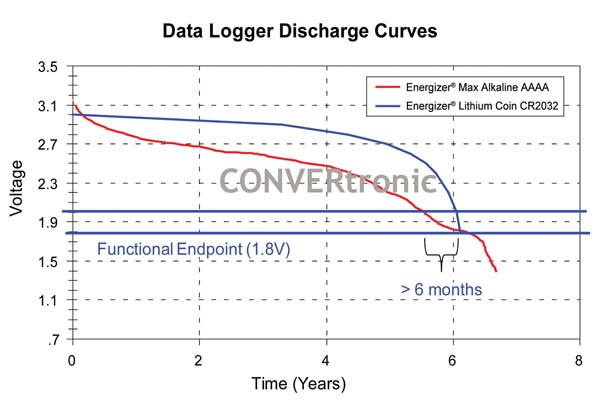
A microcontroller that can operate at low voltage is also crucial for maximizing battery life. Figure 2, reproduced courtesy of Energizer, illustrates the operating life of an alkaline lithium coin cell battery in a typical data logger; most of the time it is in a low-power state, with occasional reactivations to process information. The graph demonstrates that by operating in a lower-voltage mode, the recommended five-year lifespan for an AAAA alkaline battery can be extended by an additional six months.
Increased Reliability:
The microcontroller's oscillator influences numerous aspects of system performance, cost, manufacturability, and reliability. Modern microcontrollers not only operate at higher speeds but can also run at full speed without an external clock source and provide a wide range of internally generated clock frequencies. This allows the software to switch to a lower frequency to remain within operating specifications when the voltage drops, or to increase the speed when a power supply is added.
 Achieving reliable crystal startup is another common manufacturing challenge. Causes of unreliable startup include variable component quality, flux residue, and circuit design flaws. Many of these problems can be avoided by ensuring high-quality crystals and applying design and testing techniques, such as negative resistance tests provided by crystal and microcontroller manufacturers. For low-frequency circuits in particular, crystal biasing can be useful. This allows for increasing the bias to ensure reliable startup under various conditions, or decreasing it to reduce power consumption.
A crucial feature for improving reliability is fail-safe clock monitoring, which continuously monitors system clock transitions. When a few transitions are missed, the fail-safe clock monitor automatically switches the clock source to the internal oscillator and interrupts the CPU. This allows the microcontroller to maintain critical functions and perform a controlled shutdown.
Another factor influencing reliability is that data EEPROM is often replaced by software emulation in Flash memory, even though some applications still require independent data storage. Newer-generation microcontrollers integrate high-durability data EEPROM, up to 100,000 write/erase cycles, but these are not yet cost-effective for portable industrial applications. However, the minimum voltage range for write operations should be considered, as it may be higher than the microcontroller's minimum operating voltage, thus limiting the actual operating range.
 Noise Management:
Although low-voltage microcontrollers can be used in applications requiring high reliability, a 5V power supply can simplify board design, increase noise immunity, and improve support for existing designs. However, as geometries shrink, the availability of new 5V microcontrollers decreases. In response to the continued demand for 5V operation, chip manufacturers have developed new ways to operate at higher voltages using smaller and less expensive geometries.
To further enhance noise immunity, different types of input buffers used on port and peripheral pins support different functions even when multiplexed on the same pin. Schmitt trigger inputs offer wider input thresholds than their TTL counterparts and increase the system's noise tolerance.
The high port control resistance is another important design aspect that goes beyond simply controlling the LEDs. This high control resistance prevents unwanted coupling near noisy circuits such as switched-mode regulators and high-speed PWM signals. The increased radiated noise can be mitigated by using a small RC filter on the port pin to maintain the benefits of the high control resistance.
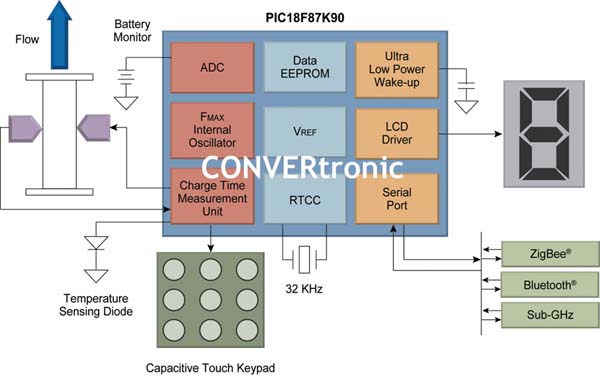 A good example of the aspects discussed in this article is the flow meter shown in Figure 3. The CTMU (Charge Time Measurement Unit) integrated into the microcontroller reads the flow rate, temperature, and the capacitive keypad of the meter. The battery voltage is monitored by a 12-bit differential A/D converter and a voltage reference, while the low-power startup module initiates periodic reactivations. This design demonstrates that by using the functions offered by the latest microcontrollers, a robust, low-power design can be achieved that is also capable of high performance levels.
Author:
David Otten and Joel Mach of Microchip Technology Inc.





