





The RF module is a high-performance, low-cost OOK/GFSK transceiver for wireless applications in the ISM bands. It incorporates a highly integrated sub-1GHz transceiver and a baseband modem with programmable GFSK data rates from 2 Kbps to 250 Kbps and OOK data rates from 0.5 Kbps to 20 Kbps. Data handling features include 64-byte FIFO TX/RX and packet handling such as CRC generation, forwarding error correction, data whitening, and Manchester encoding.
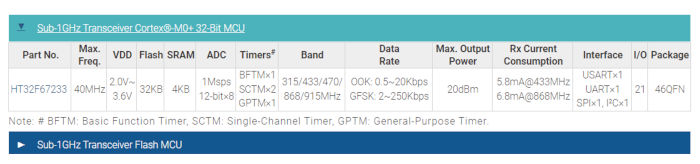
The device operates at frequencies up to 40 MHz, contains 32 KB of Flash memory, 4 KB of SRAM, and provides a maximum RF transmission power of +20 dBm. A low-IF, low-noise receiver can achieve a sensitivity of -117 dBm at a data rate of 2 Kbps in the 433 MHz band. Its receive current can be as low as 5.8 mA at 433 MHz, and it offers a TX output power of +19 dBm with a current consumption of 71 mA. It integrates a Class E power amplifier capable of delivering up to +20 dBm output power in the 433/868 MHz bands.
The device also includes an Auto-Transmit-Receive (ATR) function, and both the loop filter and XO charge capacitors are integrated on the chip to minimize the need for external components.
Regarding interfaces, it features 21 GPIO pins and multiple communication/peripheral interfaces, such as ADC, I2C, USART, UART, SPI, GPTM, SCTM, BFTTM, WDT, SW-DP (Serial Cable Debug Port), etc., implemented on the device. Various power-saving modes provide flexibility for maximum optimization between wake-up latency and power consumption, a particularly important consideration in very low-power applications.
It is supplied in a compact 46-pin QFN package (6.5mm × 4.5mm × 0.75mm).
In addition to the manufacturer's own development tools, the following are also available:
- KEIL IDE, which is supported free of charge
- Commercial debuggers for Cortex M0+ families.





