

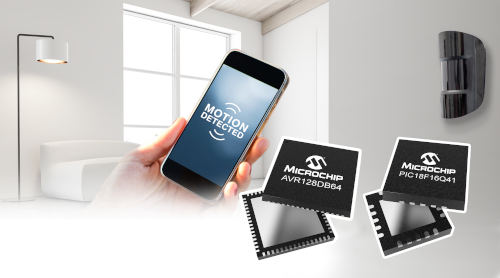
To address this challenge through greater microcontroller integration, Microchip Technology Inc. has announced the PIC18-Q41 and AVR DB , which are the first to combine advanced analog peripherals and multi-voltage operation and peripheral connections to increase system integration, reduce signal acquisition times, and offer the convenience and efficiency of working in a single design environment.
“Microchip brings easy-to-use analog capabilities to affordable PIC® and AVR® microcontrollers so designers can meet the requirements of large IoT systems,” said Greg Robinson, associate vice president of marketing for Microchip’s 8-bit microcontroller business unit. “A comprehensive, unified development tool allows designers to use these microcontrollers as a single-chip controller or as a component for intelligent analog signal conditioning in a larger system.”.
To address the need for signal conditioning in space-constrained sensing and measurement applications, such as end nodes in IoT and industrial systems, medical devices, wearables, automotive systems, and lighting, the
PIC18-Q41 microcontroller features an operational amplifier (Op Amp) and an analog-to-digital converter (ADC) with compute and digital-to-analog converters (DACs). It is particularly well-suited for large-scale IoT and AI edge systems incorporating predictive maintenance nodes for smart factories. Available in compact 14-pin packages, the PIC18-Q41 is also a good complement to Microchip's 32-bit microcontrollers and other controllers requiring analog integration.
Mixed-signal IoT systems often include multiple power levels; the AVR DB microcontroller simplifies these designs and reduces costs by integrating true bidirectional level controllers. This enables cost reduction in numerous applications, such as automotive, household appliances, HVAC, and liquid measurement. The inclusion of three independent and highly configurable operational amplifiers, a
12-bit differential ADC, a 10-bit DAC, three zero-crossing detectors, and Core Independent Peripherals (CIPs) makes the AVR DB microcontroller ideal for virtually any application involving analog signal conditioning and processing functions.
Development Tools:
The PIC18-Q41 and AVR DB microcontroller families are supported by the MPLAB® X IDE (Integrated Development Environment), as well as its MCC (MPLAB Code Configurator) and the MPLAB Mindi™ Analog Simulator. MCC is a free software extension that provides a graphical interface for configuring peripherals and functions specifically for a given application. In addition to MCC, AVR DB microcontrollers are supported by Atmel START, Atmel Studio, and third-party tools such as IAR and the GCC C compiler. MCC and START make it easy for analog and digital system designers to configure an operational amplifier system for various applications using a graphical user interface without the need for coding.
Both microcontroller families offer a compact and affordable development board for programming and debugging: the PIC18F16Q41 Curiosity Nano Evaluation Kit (EV26Q64A) and the AVR DB Curiosity Nano Evaluation Kit (EV35L43A). Quick start guides are available for both the PIC and AVR microcontrollers, allowing you to begin projects immediately.
Pricing and Availability:
The PIC18-Q41 and AVR DB microcontrollers are available in various memory sizes, packages, and price points. The starting price for the PIC18-Q41 is $0.65 for orders of 10,000 units, while the starting price for the AVR DB is $0.95 for orders of 10,000 units.