




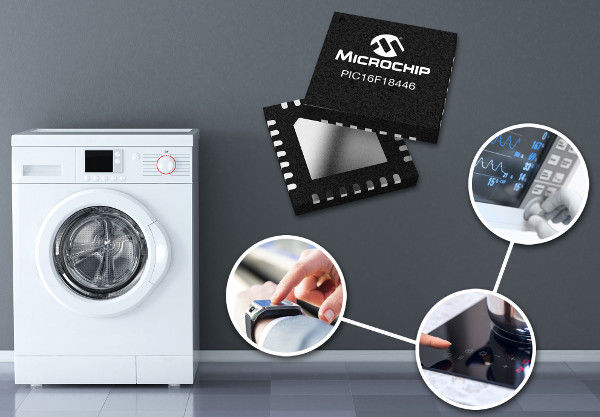
 The new PIC16F18446 family of microcontrollers comprises components ideal for sensor nodes. Flexibility was a key consideration in the design of the PIC16F18446, and its A/D converter with compute (ADC2) operates between 1.8V and 5V, ensuring compatibility with most output sensors, both analog and digital. The 12-bit ADC2 performs autonomous filtering, providing more accurate analog sensor readings and ultimately higher-quality data for the end user. Because the ADC2 activates the core only when needed, rather than by default, system power consumption is reduced, making this microcontroller ideal for battery-powered applications. This lower power consumption also allows sensor nodes to be powered by small batteries, thus reducing maintenance costs for the end user and the overall size of the design.
The arrival of the ATmega4809 introduces a new series of megaAVR® microcontrollers designed for highly responsive control applications. The processing power of the integrated high-speed A/D converter enables faster conversion of analog signals, resulting in deterministic system responses. As the first megaAVR device to incorporate CIP (Computer-Integrated Programming), the ATmega4809 can execute tasks in hardware rather than software.
This reduces the amount of code and can greatly decrease the effort required for software development, thus shortening time to market. For example, the Configurable Custom Logic (CCL) peripheral can connect the A/D converter to a custom combination of external triggers via hardware without interrupting the core, improving response time and reducing power consumption. The ATmega4809 can also be added to a system to take over functions in more complex microprocessor-based designs. By using CIP to execute instructions and control tasks on the microcontroller, rather than the microprocessor, the risk of delayed responses is reduced, thereby improving the end-user experience.
 The ATmega4809 has been selected as the microcontroller for the next-generation Arduino board. The inclusion of the ATmega4809 on this board allows developers to spend less time coding and more time creating. Hardware-based CIPs enable more efficient designs and make the transition from project to production easier than ever.
“The adoption of the ATmega4809 by the next-generation Arduino board strengthens our collaboration, while also adding the advantages of CIPs and smart analog circuitry to the Arduino platform,” said Steve Drehobl, vice president of Microchip’s 8-bit microcontroller business unit.
Development Tools:
The new PIC16F18446 microcontrollers are compatible with MPLAB PICkit™ 4 (PG164140), Microchip’s new tool for low-cost in-circuit programming and debugging. The Curiosity Development Board (DM164137), a feature-rich board for rapid prototyping, can also be used to get started with these microcontrollers. Both development tools are supported by the MPLAB X Integrated Development Environment (IDE) and the cloud-based MPLAB Xpress IDE. In addition, MPLAB Code Configurator (MCC) is a free software extension that provides a graphical interface for configuring peripherals and functions in any application. Designers who want to start developing immediately can download quick-start code samples and order a free MPLAB Xpress PIC16F18446 Development Board, available for a limited time.
Rapid prototyping with the ATmega4809 is supported by the ATmega4809 Xplained Pro Evaluation Kit (ATmega4809-XPRO). The kit is USB-powered and includes touch buttons, LEDs, and expansion strips for quick setup, as well as a programmer/debugger that fully integrates with Atmel Studio 7 IDE and Atmel START, a free online tool for configuring peripherals and software that accelerates development.
The Curiosity development board and ATmega4809 Xplained Pro evaluation kit have a mikroBUS™ compatible socket that makes it easy to incorporate sensors, actuators, or communication interfaces from Mikroelektronika's extensive click boards™ library.
Pricing and Availability:
The PIC16F18446 and ATmega4809 devices are now available with various memory sizes, pin counts, and package options for volume production.
• The MPLAB PICkit 4 programmer/debugger is now available for $47.95.
• The Curiosity development board is now available for $20.00.
• The ATmega4809 Xplained Pro evaluation kit is now available for $38.00.
For more information, contact a Microchip sales representative or authorized distributor. To purchase products mentioned in this press release, visit Microchip's online retail channel, microchipDIRECT, or contact an authorized distributor.





