

 To understand what influences microcontroller manufacturers, we need to analyze regional drivers and drivers for specific applications. According to IHS iSuppli’s latest study on the microcontroller market in China, the main growth areas are data processing (with a compound annual growth rate of 12%) and microcontroller applications (with a compound annual growth rate of 7%), with the industrial automotive and electronics markets leading this growth as domestic and international automakers expand their production capacity in China.
Designers have witnessed a greater availability of proprietary 32-bit cores with microcontrollers based on ARM Cortex processors, and are no longer restricted to just a few vendors of proprietary architectures. A broad and growing ecosystem has developed around ARM-based microcontrollers, including third-party tools for compilers, real-time operating systems, software, and LCD graphics, among others. Driven by the need for drivers and fueled by the success of ARM Cortex cores, the 32-bit segment is the fastest-growing area of the microcontroller market. Engineers are tempted to switch from their 8-bit and 16-bit designs to the newer Cortex-M3 and -M0-based microcontroller families.
Powering the Internet of Things:
ARM announced the “Flycatcher” architecture in March 2012, suggesting that refrigerators and other household appliances, medical equipment, energy meters, and home and office lighting would benefit from being able to connect with each other to form intelligent distributed systems. Flycatcher, officially named Cortex-M0+, is specifically designed for devices that cannot be connected to the electrical grid and must be battery-powered. The Cortex-M0+ architecture was designed to offer chip manufacturers a way to build microcontrollers that require “ultra-low power” but have the ability to process 32 bits.
Cortex-M0+ core CPUs measure just one square millimeter, and the microcontrollers use about a third less power than their predecessors, which offered only 8 and 16 bits of capacity. They are designed to be low-loss components that offer long standby battery life, lasting for years instead of months.
Devices that incorporate such connectivity and long lifespan performance can form an integral part of smarter power systems, creating a “design response” that allows them to power on or go
into standby mode, helping to address fluctuations in power demand.
Currently, there are an estimated 12.5 billion internet-connected devices, an average of two per person, many of which are phones and computers. By 2025, Cisco predicts there will be one trillion such devices. ARM expected the microcontrollers to sell for between 13 and 20 pence each, and will charge its customers a royalty fee of between 1% and 2% of that price in addition to the cost of the license.
The Kinetis-L range isn't wasting any time.
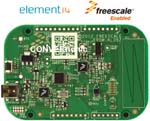
NXP Semiconductors and Freescale already have licenses for the Cortex-M0+ architecture. Freescale has been the primary M0+ customer with the launch of the Kinetis-L range. Geoff Lees, Vice President of Industrial Microcontroller and Multimarket Sales at Freescale, said that the M0+ core is “strategically important.” “We want to offer our 8-bit and 16-bit customers a window into the 32-bit market. And cost is a key factor in convincing them to begin the evaluation.”
The M0+ core has 1.77 CoreMark/MHz with an energy efficiency of 42.14 CoreMark/nA, and both values are significantly better than the closest 8-bit and 16-bit competition.
In distributed intelligent systems, because there are so many interconnections, energy efficiency in one device repeated in many others offers significant savings.
Enhancements to Cortex-M0+ Processors:
The Kinetis-L family is manufactured using Freescale's 90nm thin-film storage (TFS) processing technology with low leakage and offers a wide selection of on-chip flash memory densities, extensive analog connectivity, and peripheral options including:
- Two-phase simultaneous processing, enabling faster execution of derived instructions with fewer clock cycles and minimal power consumption.
- Two to ten times better performance than 8-bit and 16-bit architectures.
- World-leading power efficiency, maximizing stack life and enabling the creation of smaller, lighter applications.
- Single-cycle I/O and peripheral access, improving response time to external events.
- 4GB linear address space, eliminating complex page schemes and simplifying software architecture.
- The micro-tracing buffer provides a cost-effective and simple debugging solution, allowing for faster identification and correction of errors without requiring additional I/O resources.
Full product information is available at http://bit.ly/FRDM-KL05Z
Author:
Bee Thakore, European Technical Marketing Manager at Farnell element14