



As the need for efficient equipment and machinery operation continues to grow, early fault detection and improved maintenance efficiency have become key challenges. Equipment manufacturers are seeking solutions that enable real-time monitoring of operational status while avoiding the drawbacks of network latency and security risks. However, standard AI processing models often rely on high-performance CPU and network connectivity, which can be expensive and difficult to deploy.
In response, ROHM has developed innovative AI-powered MCUs that enable autonomous AI learning and inference directly on the device. These grid-independent solutions allow for the early detection of anomalies before equipment failure occurs, contributing to more stable and efficient system operation by reducing maintenance costs and the risk of line shutdowns.
The new products adopt a simple three-layer neural network algorithm to implement ROHM's exclusive "Solist-AI™" on-device AI solution. This allows the MCUs to perform learning and inference independently, without requiring a cloud or network connection.
AI processing models are generally classified into three types: cloud-based AI, edge AI, and endpoint AI. Cloud-based AI performs both training and inference in the cloud, while edge AI uses a combination of cloud and on-premises systems, such as factory equipment and PLCs, connected via a network. Typical endpoint AI performs training in the cloud and inference on local devices, so a network connection is still required. Furthermore, these models often perform inference using software, which necessitates the use of high-performance GPUs or CPUs.
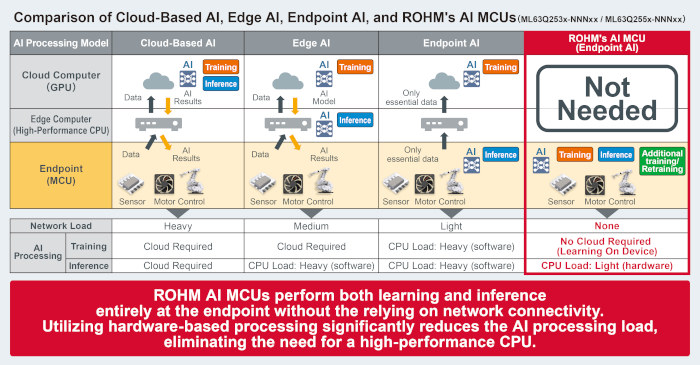
In contrast, ROHM's AI MCUs, while classified as endpoint AI, can independently perform both learning and inference through on-device learning. This enables flexible adaptation to different installation environments and variations between units, even within the same equipment model. Equipped with ROHM's exclusive "AxlCORE-ODL" AI accelerator, these MCUs offer AI processing approximately 1000 times faster than ROHM's conventional software-based MCUs (theoretical value at 12 MHz), allowing for real-time detection and numerical output of anomalies that deviate from the norm. Furthermore, high-speed (on-site) learning is possible at the point of installation, making them ideal for retrofitting existing equipment.
These AI-powered MCUs feature a 32-bit Arm® Cortex®-M0+ core, a CAN FD controller, a three-phase motor control PWM, and two A/D converters, enabling them to achieve a low power consumption of approximately 40 mW. This makes them ideal for fault prediction and anomaly detection in industrial equipment, residential installations, and household appliances.
The range will consist of 16 products with different memory sizes, package types, pin counts, and packaging specifications. Serial production of eight models in TQFP packaging began sequentially in February 2025. Among them, two models with 256 KB of code flash memory and tape packaging are available for purchase, along with an MCU evaluation board, through online retailers.
ROHM has launched an AI simulation tool (Solist-AI™ Sim) on its website that allows users to evaluate the effectiveness of learning and inference before implementing an AI-powered microcontroller (MCU). The data generated by this tool can also serve as training data for the actual AI-powered MCU, enabling validation of the initial implementation and improvement of inference accuracy.
To facilitate adoption, ROHM has created an ecosystem in collaboration with partner companies, offering comprehensive support for model development and integration. In the future, ROHM will continue to expand this ecosystem, providing more user-friendly environments, assisting in the creation of training data, and proposing optimal implementation methods.
About Solist-AI™ (On-Device Learning IC Solution for Autonomous AI)
Solist-AI™ is ROHM's on-device AI solution designed for edge computing applications. Inspired by the musical term "soloist," meaning a solo performance, this innovative solution enables real-time learning and inference directly on autonomous edge devices without relying on cloud servers. Featuring ROHM's proprietary on-device learning AI technology, Solist-AI™ is characterized by its compact design and low power consumption, contributing to the expansion of sustainable AI innovation.
Solist-AI™ is a trademark or registered trademark of ROHM Co., Ltd.
Product Range:
These AI-powered MCUs integrate a 32-bit Arm® Cortex®-M0+ core (maximum operating frequency: 48 MHz) and ROHM's proprietary AxlCORE-ODL AI accelerator, which performs learning and inference using a three-layer neural network. Furthermore, by leveraging versatile timing functions, such as PWM control of three-phase motors, along with a wide range of serial interfaces, including CAN FD and a 12-bit A/D converter, they enable flexible support for control and data processing in industrial equipment, residential installations, and household appliances.

Support Tools for AI MCU Development:
ROHM's AI MCUs utilize a standard Arm® core, ensuring compatibility with commercially available tools and ROHM's unique integrated development environment. To assess learning and inference, an AI performance verification simulator is provided, along with a real-time viewer for evaluating AI effectiveness.
For more details on the MCU AI development support system and an overview of each product, please refer to ROHM's dedicated MCU AI development support system page (below).
https://www.rohm.com/lapis-tech/product/micon/solistai-software
Products available
Arm® Integrated Development Environment: Arm® Keil® MDK;
Arm® Debug Adapter: Debugger for connecting a computer to the Arm® core;
USB-SPI Conversion Adapter: Adapter for connecting the AI MCU to the Solist-AI™ Scope
Both the MCU AI and MCU evaluation boards are offered through online distributors as they become available. (Release date: March 2025)
MCU AI Product Information
Sales Reference Numbers: ML63Q2537-NNNTBZWBY, ML63Q2557-NNNTBZWBY
MCU Evaluation Board Information
Sales Reference Numbers: RB-D63Q2537TB48, RB-D63Q2557TB64
Application Examples
Industrial automation (FA) sensors, motors, batteries, power tools, residential installations, household appliances, robots. Other uses include devices requiring fault prediction, equipment where downtime is unacceptable, and systems demanding higher prediction accuracy.
AI-powered MCU Use Cases:
High-precision anomaly detection and condition monitoring are possible by combining AI-powered MCUs with various sensors.
FA Sensor + AI MCU:
Uses data such as light, temperature, flow rate, and sound to monitor equipment condition and detect anomalies. It also performs anomaly detection and degradation prediction for the sensing units themselves, including FA sensors.
Motor + AI MCU:
Monitors motor current, temperature, and rotational speed to detect load anomalies and bearing damage.
Accelerometer + AI MCU
: Tracks vibration levels to implement condition-based maintenance (CBM) using criteria tailored to each specific machine.
AE (Acoustic Emission) Sensor + AI MCU:
Enables ultra-early detection of mechanical anomalies through the collective analysis of key AE indicators (peak amplitude, average value, energy, and count).
Residential Installations/Appliances + AI MCU:
Leverages data from existing sensors to detect equipment anomalies early, determine maintenance requirements, estimate undetected parameters, and predict the time required for specific operations.
Industrial Robots + AI MCU:
Detects anomalies and the optimal timing for adjusting various robot components using peripheral sensors (endpoints) and the AI MCU, and transmits only the results to the main CPU.
Note: DigiKey™, Mouser™, and Farnell™ are trademarks or registered trademarks of their respective companies. Arm®, Cortex®, and Keil® are registered trademarks of Arm Limited (or its affiliates) in the U.S. and other countries.
* ROHM study of June 4, 2025 on MCU products.