Terahertz waves are expected to be applied to non-destructive testing, diagnostic imaging, and detection in the medical and healthcare sectors, as well as to future ultrafast communication technologies. The supply of these devices contributes to the advancement of terahertz wave applications.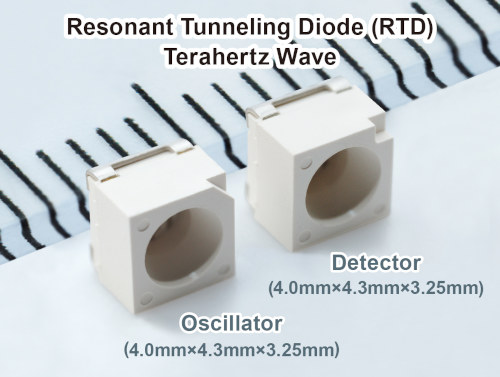
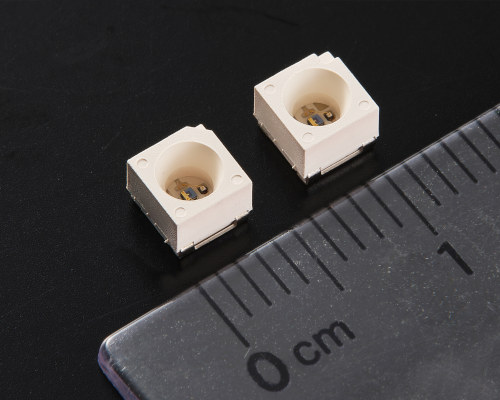
ROHM has developed a 0.5 mm × 0.5 mm RTD chip for generating and detecting terahertz waves, capable of oscillating and detecting terahertz waves at a frequency of 320 GHz (typ.) with an output power ranging from 10 to 20 µW. ROHM will begin offering samples of this RTD element mounted in a PLCC package (4.0 mm × 4.3 mm) commonly used for LEDs. With its extremely compact size—typically one-thousandth the size of conventional oscillators—this innovation enables the easy development of terahertz wave applications, even in environments with strict space constraints.
By placing the antenna surfaces of the oscillator and detector 10 mm apart, a dynamic range of 40 dB (typ.) can be achieved. Both the oscillator and detector maintain a transmission power consumption of 10 mW (typ.), while their ability to oscillate and detect terahertz waves at room temperature eliminates the need for cooling equipment required by some conventional methods. These compact, low-power devices are minimally affected by the operating environment, enabling their use in a wide range of applications.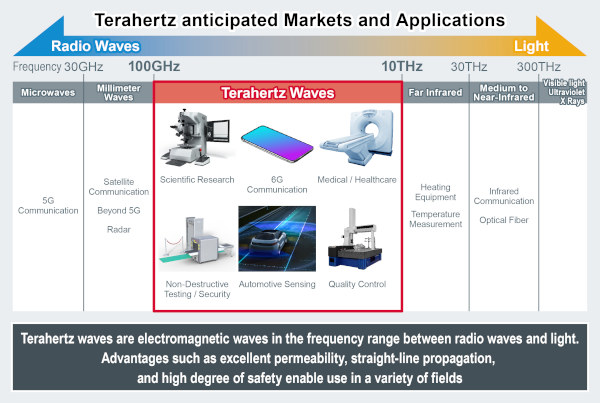
ROHM offers sample terahertz oscillation and sensing devices at less than one-tenth the price of conventional devices. ROHM also offers evaluation kits that include an evaluation board and other components, allowing users to easily integrate the devices into a research and development environment. The sale of sample products and evaluation kits requires the prior signing of a non-disclosure agreement (NDA) with ROHM.
Professor Safumi Suzuki, Laboratory for Future Interdisciplinary Research in Science and Technology, Institute for Integrated Research, Tokyo Institute of Science
: "Terahertz waves are expected to be applied to a wide variety of fields, such as imaging, sensing, and wireless communications, due to their excellent characteristics and high degree of safety. However, research and development for commercialization have traditionally required large-scale equipment and considerable costs. In this context, the RTD terahertz wave device—developed after years of research in collaboration with ROHM—is an ultra-small device measuring 4.0 mm × 4.3 m that defies conventional norms while exhibiting remarkably low power consumption and implementation costs. With the release of device samples, we anticipate that many private companies and research institutions will soon begin exploring terahertz wave research. We expect that the use of terahertz waves in various fields will lead to the creation of new applications with functions that were previously very limited." difficult to obtain. In the future, we will continue to contribute to the advancement of society by developing terahertz wave devices in collaboration with ROHM."
Ken Nakahara, General Manager of ROHM Research & Development Center, ROHM Co., Ltd.:
“The terahertz (THz) R&D team and I are very excited and proud to have reached the point where we can bring this technology to market. We have been dedicated to THz devices for about 15 years, and we can say that the journey has not been easy. Along the way, we have been able to bring together the strengths of industry, academia, and government, and have managed to consolidate the position that ROHM holds today. The team understands that this announcement is just a small step toward the commercialization of THz technology, but at the same time, it is a giant leap for us. We believe that this small beginning will soon grow into something much bigger and contribute to the well-being of our society.”
Background and Development Overview:
Occupying the frequency region between radio waves and light, terahertz waves exhibit several distinctive characteristics, including excellent permeability similar to that of radio waves, straight-line propagation similar to that of laser beams, and unique absorption properties for materials such as polymers. Therefore, they are envisioned for use in non-destructive testing, imaging of people and materials without the use of hazardous radiation, high-speed communication as an alternative to conventional wireless transmission, and high-resolution radar detection. However, conventional methods typically require large equipment and high implementation costs, often ranging from tens to hundreds of thousands of dollars, making it difficult for private companies to actively engage in research or commercialization in the field of practical terahertz applications.
Since the late 2000s, ROHM has been involved in joint research projects with numerous universities and research institutes, such as the Tokyo Institute of Science and Osaka University. The primary goal is to develop terahertz wave oscillation and detection devices using RTD technology. ROHM also participates in several consortia, including national projects (government R&D initiatives) sponsored by the Ministry of Internal Affairs and Communications (MIC), the National Institute of Information and Communications Technology (NICT), and the Japan Science and Technology Agency (JST), as well as the XG Mobile Promotion Forum and the Terahertz Systems Application Promotion Council. ROHM will continue to focus on device development while also collaborating on the rapid industrialization and social integration of terahertz technology.
ROHM
is committed to supporting research and development of terahertz applications. In addition to various support materials, ROHM also offers evaluation kits that include devices and evaluation boards.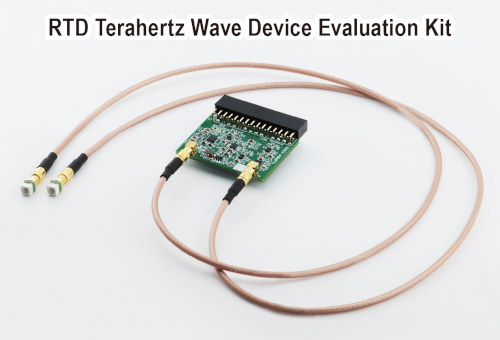
By combining measurement tools like Digilent's Analog Discovery 3™ with a computer and software, users can easily manage terahertz oscillation and wave detection devices. The miniaturization of both the device and the evaluation board allows for the creation of a research and development environment even in limited spaces, such as a desktop. For more information, please contact a sales representative or visit the contact page on the ROHM website.
Analog Discovery 3™ is a trademark or registered trademark of Digilent.
*ROHM study of June 15, 2025