

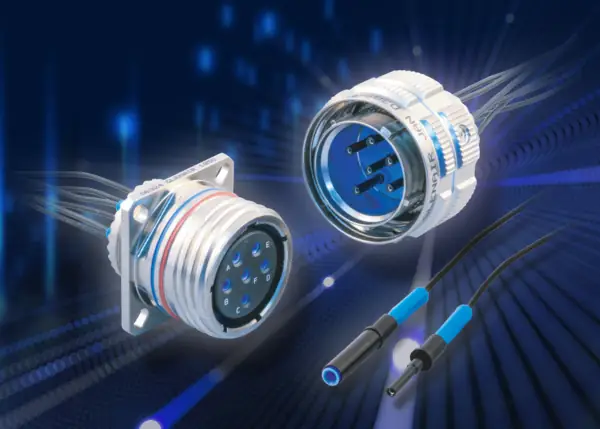
These components are designed for demanding applications such as radar transmitters, traveling-wave tube (TWT) amplifiers, missile guidance electronics, ring laser gyroscopes, mass spectrometers, and electric propulsion systems. Glenair kV Seal contact assemblies allow operation with voltages between 13.5 and 22 kVDC using standard connector platforms.
Supplied as pre-wired, insertable, and removable contacts, they integrate directly into established connector architectures such as MIL-DTL-38999, Mighty Mouse, SuperNine, and Micro-Crimp 79 series. They are also compatible with MIL-STD-1560 contact configurations incorporating non-polarized cavities in sizes 12 and 8. This modular architecture allows for the retention of existing connection systems, accessories, and qualification procedures, while incorporating high-voltage capabilities without requiring a complete redesign of the connectors.
Protection against electric arcs and dielectric breakdown
The patented design of the kV Seal contacts increases the ability to withstand high voltages and minimizes the risk of arcing, disruptive discharges, and dielectric breakdown in demanding aerospace environments. Their geometry hinders leakage currents along the interface, increasing resistance to surface tracking. Furthermore, sealing the interface air gaps and overmolding the cable strain relief system improve dielectric strength at high altitudes.
Technical characteristics of Glenair kV Seal contacts
The assemblies are available in pre-wired configurations with contacts on one or both ends and have the following features:
Size 12 contacts: compatible with 22 or 24 AWG conductors and rated voltages of 13.5 to 15 kVDC.
Size 8 contacts: compatible with 16 AWG conductors and voltages up to 22 kVDC.
Operating temperature: −55 to +125 °C.
Insulation resistance: 5,000 MΩ at 500 VDC.
Gary Evans, CEO of Powell Electronics Europe, highlights that the incorporation of these assemblies provides engineers with a high-voltage solution that can be directly integrated into existing connection systems, allowing them to expand their capacity up to 22 kV DC without redesigning previously tested architectures.