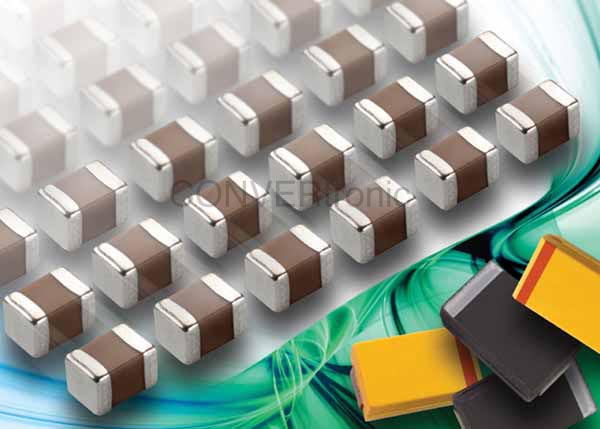
Since modern electronic devices use high-frequency digital signals, efficient noise absorption at these frequencies is essential. Ceramic capacitors are better suited to meet this requirement because their high-frequency impedance is much lower than that of their tantalum counterparts. In fact, replacing a tantalum capacitor with a ceramic one typically requires only about one-fifth of the capacitance to achieve the same noise absorption, thus reducing the component's cost.
Additional advantages of ceramic capacitors over tantalum capacitors include: less self-heating, stable capacitance over a wide frequency range, higher breakdown voltage, and increased reliability. Ceramic capacitors are not polarized like tantalum capacitors, thus simplifying the installation process during assembly, soldering, etc.