
The world of photovoltaic energy is experiencing an unprecedented boom, driven by changes in legislation and the rising cost of energy. Companies specializing in this sector are enthusiastically tackling projects, working in depth, and participating in innovative proposals. Water drainage is particularly complex, especially during the autumn when rainfall is abundant. This, coupled with variations in sea level, necessitates a series of pumping stations to facilitate water extraction from the fields. The Comunitat de Regants-Sindicat Agrícola de l'Ebre, responsible for managing the water from the left bank of the Ebro River for agriculture, needed more efficient and environmentally sustainable management.
One of their key initiatives was the installation of an autonomous pumping station in the municipality of Deltebre, designed to reduce the load on the existing station in Pal and redistribute water to improve local habitats. The key to this installation was decentralization and energy independence. To achieve this, a photovoltaic solar-powered system was designed, installing 126 solar panels of 540 Wp each near the pump to maximize efficiency. The solar system's peak power of 68.04 kWp feeds a 37 kW Controlvit variable frequency drive, which in turn powers the 25 kW pump motor. This motor drives an Archimedes screw, a pumping system suitable for liquids with suspended particles and known for its long lifespan, low maintenance costs, and quiet operation. The equipment also includes an emergency generator and a remote monitoring and control system.
Frequency converters installed on water pumps allow for a reduction in motor speed, resulting in energy savings of up to 50%. The electronic control of the frequency converter helps optimize its performance by adapting to the pump's highly variable operating conditions, which in turn depend on the hydraulic supply requirements. This optimization is achieved by varying—hence the name of the device—both the frequency and voltage supplied to the motor, thus regulating its speed. In other words, the pump motor speed is always at its optimal level.
The results so far are very promising, and the project in Deltebre is just the first of a series of similar installations planned for the left half of the delta. With an estimated payback period of approximately three and a half years, this project demonstrates that solar photovoltaic energy is not only cost-effective but also environmentally beneficial in such a fragile ecosystem.
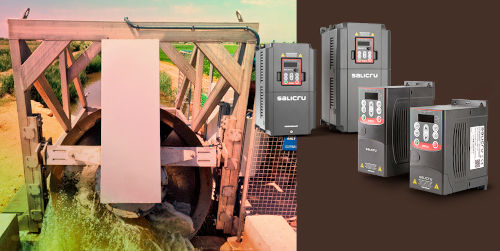
Salicru, a power electronics expert with a strong environmental commitment, has developed frequency inverters for solar pumping that combine all these attributes. The CV30-PV harnesses the radiation captured by solar panels to power the inverter with direct current, which in turn supplies alternating current to a submersible pump. There is also a version with an integrated control cabinet, the ACV30-PV, with automatic switching and booster options.