COM-HPC is the new high-performance COM standard for modular edge server and edge client designs. The smallest size, Mini, is barely larger than a credit card.
Looking back over the last two decades, in the early days of COM modules there was a wide variety of options. To begin with, many manufacturers tried to establish their concept in the market and stand out by differentiating the form factor. However, going it alone was difficult in a market that was still young and had many small players. Customers demanded uniform standards for greater design reliability and to allow for secondary provisioning. This initially led to the formation of small alliances and consortia to establish individual form factors such as DIMM-PC or ETX. But to achieve full acceptance among users, these efforts ultimately resulted in the development of independent standards, now hosted by the standards bodies PICMG and SGET. This greatly simplified the selection of a suitable standard.
Plenty to Choose From.
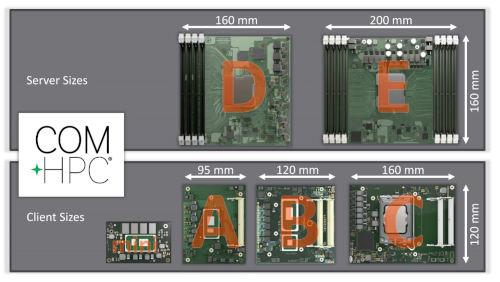
However, today there is still a wide variety of form factor standards as a result of technological advancements. If we limit ourselves to client systems with integrated graphics support, the offering ranges from Qseven, µQseven, and SMARC to COM Express Basic, Compact, and Mini in Type 6, as well as COM Express Basic, Compact, and COM-HPC in Mini, Sizes A, B, and C. Furthermore, there are COM Express in Type 7 and COM-HPC in Sizes D and E as headless systems for embedded and edge server designs.
Therefore, developers today have several options if they want to use an application-ready COM plug-in module in their dedicated systems. 
13th Generation Intel Core Processors: Available at congatec in both COM Express Compact and COM-HPC Client Size C, A and Mini (from left)...
Although the term SOM (System-on-Modules) is commonly used in the Arm processor world, all these terms refer to the same principle: the core computing component is presented as a bootable component with full software support for all interfaces specified in the standard. With the appropriate evaluation boards, developers can immediately implement their application, while the dedicated motherboard and its integration into the system are developed in parallel. This is simpler than a completely custom design, as the standards' design guidelines offer many valuable suggestions, and a rich ecosystem of IP and off-the-shelf (COTS) components is available.
COM-HPC Will Dominate High-Performance Types.
However, the current choice struggle is limited. The new COM-HPC standard from the PICMG specifies an immensely broad ecosystem that will completely dominate the next generation of high-performance embedded and edge computing applications. Therefore, all new high-end designs should be based on COM-HPC, regardless of whether they are high-performance dedicated edge servers or edge clients. As a predecessor standard, COM Express is only recommended for existing designs to save on NRE investment when increased performance is not required. Furthermore, the recently introduced COM-HPC Mini standard offers a highly efficient migration path for COM Express Compact designs, which was previously unavailable.
 SMARC is the low-power form factor for Arm and x86 processors that allows for very compact designs with low-cost edge card connectors. The kit shown in the image is an NXP i.MX8 Plus-based SMARC module with bracket, heatsink, and Basler chamber.
Measuring 95x120 mm (11,400 mm²) and until now the smallest COM-HPC standard, COM-HPC Size A was still almost 32% larger than COM Express Compact, which measures 95x95 mm (9,025 mm²). In terms of footprint, this is 25 mm too wide for migrating existing COM Express designs to COM-HPC. Since COM Express Compact is the most widespread COM Express form factor, and only high-end systems currently use the even larger COM Express Basic form factor, many developers faced considerable challenges, if only in terms of system design dimensions. But smaller always fits. That's why COM-HPC Mini, at 95x60 mm, is a true game-changer, opening up entirely new possibilities, particularly for the numerous ultra-compact system designs.
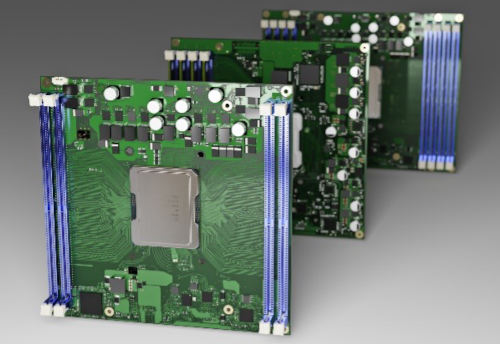
congatec's COM-HPC Size D server modules with Intel Xeon D-2700 processors deliver massive edge server performance with up to 20 cores and target mixed mission-critical applications with consolidated workloads.
SMARC is destined for low-power, low-cost designs
. But can COM-HPC really be all-encompassing? In theory, the answer is yes. But the reality is different, because in addition to PICMG, there are also the SGET standards, whose main focus is low-power processing. Among the SGET standards, SMARC is usually preferred over Qseven because the connector is newer, the number of pins is higher, and the form factor is smaller. However, designs using the edge connector, whether Qseven or SMARC, are invariably less expensive than those using the PICMG standard. Therefore, small form factor designs with low-power processors are expected to favor this standard, and COM-HPC Mini may not be able to fully penetrate this market segment. Nevertheless, any application requiring high performance in a small form factor will be better suited to COM-HPC Mini. Therefore, choosing the right form factor is now much simpler. It's only when choosing between SMARC and COM-HPC Mini that things get more complicated. However, in cases where the target device requires a low-power or low-cost design rather than compact high performance, the design decision is also straightforward. And when it comes to standards, one thing is certain: the embedded systems community will continue to support the full range of available standards. Therefore, new designs are well-suited to either COM-HPC or SMARC.
Author*: Christian Eder is Product Marketing Director at congatec