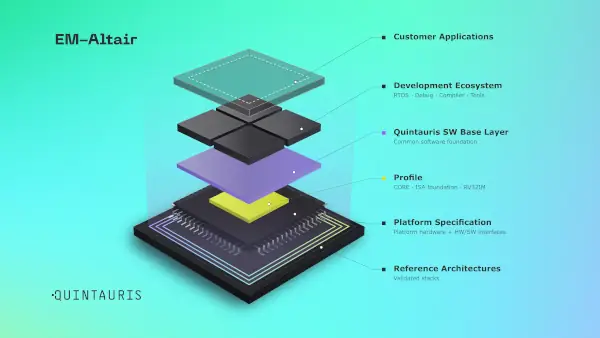
The platform establishes common hardware, firmware, and runtime environment requirements, enabling applications to be developed once and used on various compatible devices without imposing a specific microarchitecture. With this initiative, Quintauris aims to reduce fragmentation within the RISC-V ecosystem and facilitate its adoption in industrial and automotive applications that demand deterministic behavior, security, and software stability.
A common architecture for RISC-V microcontrollers
The flexibility of RISC-V has facilitated its expansion into embedded systems, but it has also led to differences between implementations in aspects such as interrupt handling, memory models, and compatibility with real-time operating systems (RTOS). EM-Altair addresses these differences by defining a common runtime environment that includes the instruction profile, privilege architecture, boot and runtime services, and security mechanisms. The platform is based on the specifications ratified by RISC-V International and adds specific requirements to ensure practical interoperability between devices.
Based on RV32IM and ready for real-time applications
EM-Altair is based on the RV32IM architecture, with a defined set of required and optional extensions. This configuration provides developers with a stable target for aspects such as interrupts, atomic operations, control and status registers (CSRs), and memory access ordering. The platform also defines a high-performance, bounded-behavior interrupt architecture, geared toward applications with stringent real-time requirements.
In terms of isolation, it incorporates mechanisms based on Physical Memory Protection (PMP) to separate trusted and untrusted code using Machine mode and, optionally, User mode.
Functional safety for automotive and industrial applications
The platform is designed to align with functional safety practices equivalent to ASIL-B and includes mechanisms to support firmware integrity and device protection. Its intended applications include electronic body systems, zonal controllers, infotainment units, and energy management systems for electric vehicles. It is also geared toward industrial control systems, IoT sensor nodes, and wearable devices.
The goal is to provide a common foundation that facilitates the development of reusable software on teams with different silicon implementations.
Validation and certification using QNTAF
EM-Altair is complemented by QNTAF, the validation and certification framework developed by Quintauris. This tool allows for the execution of performance, compliance, and functional safety tests across various environments, including cloud systems, simulators, and FPGA platforms. QNTAF also facilitates the integration of tests into CI/CD processes and the generation of traceable documentation to support certification procedures.
According to Angel Berrio, Chief Product Officer of Quintauris, EM-Altair provides a stable foundation that allows manufacturers to differentiate their hardware implementations while software teams work on a common environment.