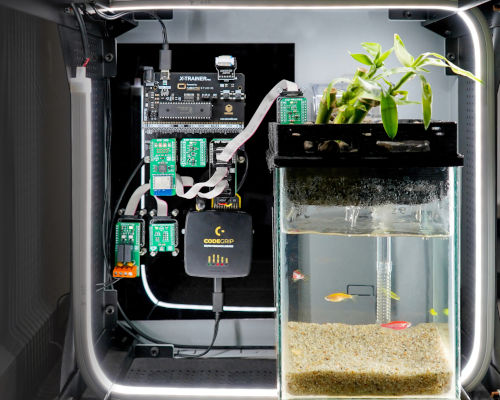
The project aimed to demonstrate the practical application of the MIKROE toolchain at the IoT Day Guadalajara 2023 event. Initially, Microside's goal was to monitor temperature and humidity using its X-TRAINER PRO development board, powered by MIKROE's integrated development environment, NECTO™, and Click boards, and then display this data on Click Cloud. However, the company soon realized that it would be possible to create a complete aquaponics system, monitoring and controlling a wider range of variables that would have a greater impact.
Microside selected the following Click boards for the aquaponics system:
Environment Click™ - measures ambient temperature and humidity.
Light mix-sense Click™ - measures ambient light.
Hydro Probe Click™ - measures soil moisture.
Relay Click™ - controls the water pump when certain conditions are met.
Shuttle Click™ and mikroBUS shuttle™- increases the number of mikroBUS sockets available on the MIKROE development board.
Terminal Click™ - with an analog pin, a 3.3V pin and a GND pin, allowing an LM35 watertight probe temperature sensor to measure water temperature.
G2C Click™ - connects to the Click Cloud IoT service.
From this, Microside was able to create a complete aquaponic ecosystem that remotely monitors ambient temperature and humidity, ambient light, water temperature, growing medium moisture, and also features automated pump control for continuous water flow.
The microcontroller specified for the design was the Microchip PIC18F47K42, compatible with MIKROE's mikroSDK software development kit, which enables code portability and accelerates development. The entire system runs through the NECTO IDE, and programming and debugging were performed remotely via Wi-Fi using Planet Debug, MIKROE's remote development platform.
Nebojsa Matic, Managing Director of MIKROE, commented: "This project is a superb example of how a small team can create a complex system in a very short time using our full range of low-cost embedded development tools."
All the details of the aquaponics project, including a demonstration video, can be found here.